

Case Study: Large-Scale Coal Mine (Open-pit & Underground)
In the daily operations of large coal mines, especially those combining open-pit and underground mining, communication blind spots are a continuous threat to safe production and efficient coordination:
High-Angle Shielding in Open-pit Depressions: As open-pit mines deepen, they form massive funnel-shaped cavities. Towering, mineral-rich rock walls absorb and block radio waves, creating severe blind spots between the pit floor and the surface command center.
Signal Obstruction in Complex Underground Tunnels: Underground tunnels stretch hundreds of meters with complex turns. Traditional wireless signals decay rapidly at curves because they cannot travel via line-of-sight.
Exorbitant Infrastructure Costs: Traditional communication brands usually propose complex networks with large base stations, kilometers of fiber cables, and massive power backups. These systems are slow to construct and can be damaged by blasting, landslides, or mining shifts.
Electromagnetic Interference from Heavy Machinery: Massive dump trucks, excavators, and drilling rigs act as physical obstacles and generate electrical noise, disrupting ordinary walkie-talkie signals.
One of our agricultural clients in Ghana, operating an expansive farm with dense foliage, developed an engineering solution that can be adapted to mining environments:
Deployment Practice: Three KANGLONG D7000 solar-powered self-organizing mesh relays were deployed with 20-meter low-loss feeder cables. High-gain omnidirectional antennas were mounted on the tops of tall palm trees.
Effectiveness Evaluation: The natural elevation of the palm trees provided a clear, unobstructed line of sight. The 20-meter cable allowed the D7000 host units to remain at ground level for easy solar charging and maintenance. The design bypassed hilly terrain and thick canopy, expanding the signal footprint.
Adapting High-Elevation Antennas to Mine Environments
Although palm trees are absent in coal mines, the concept of combining long, low-loss feeder cables with high-elevation antennas can be transferred directly to mine infrastructure.
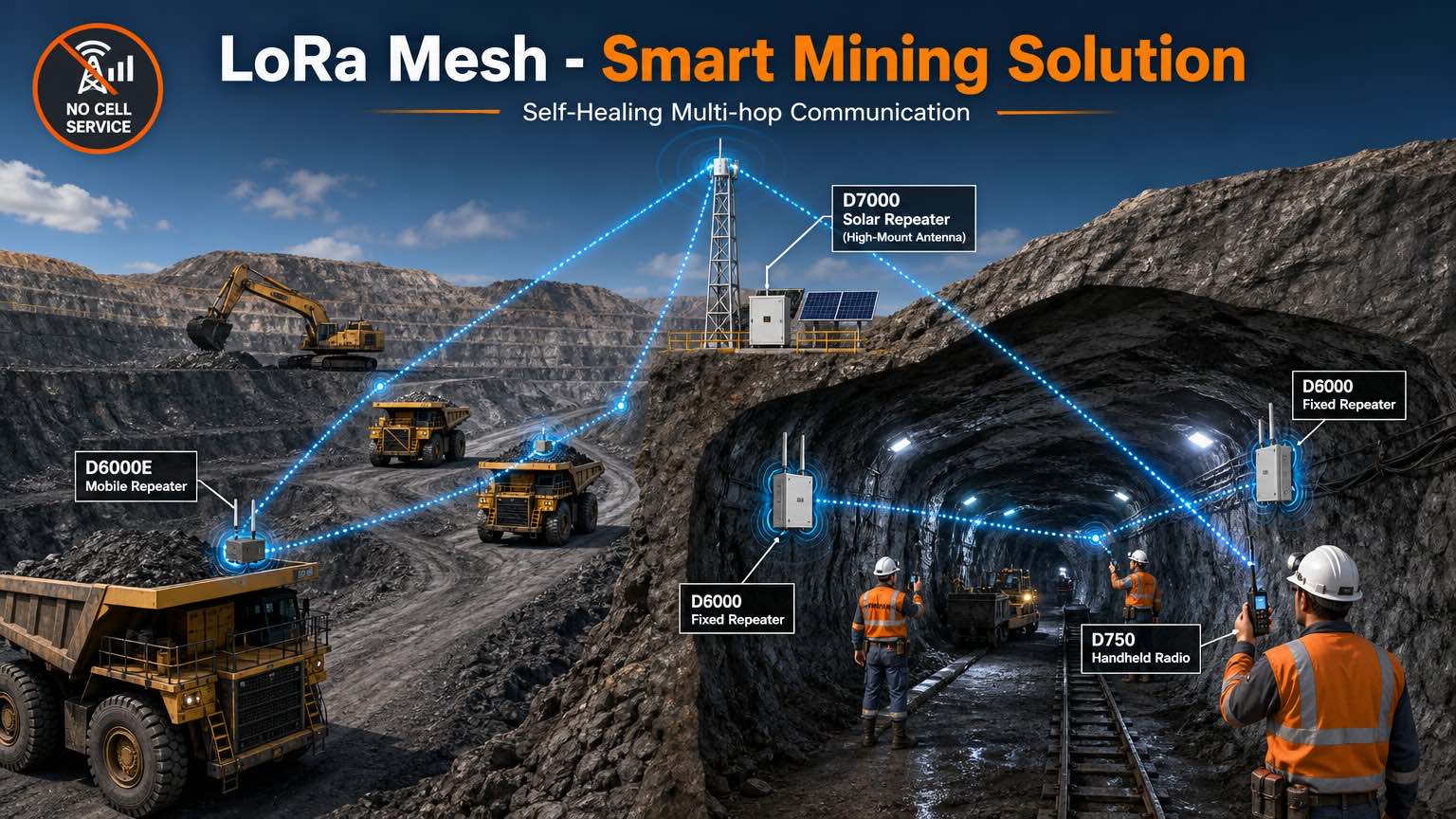
Instead of relying on single-point base stations, the architecture uses KANGLONG's LoRa self-organizing mesh technology to create an integrated, self-healing Air-Ground-Tunnel network.
1. Open-Pit High Point: “Eye in the Sky” Node
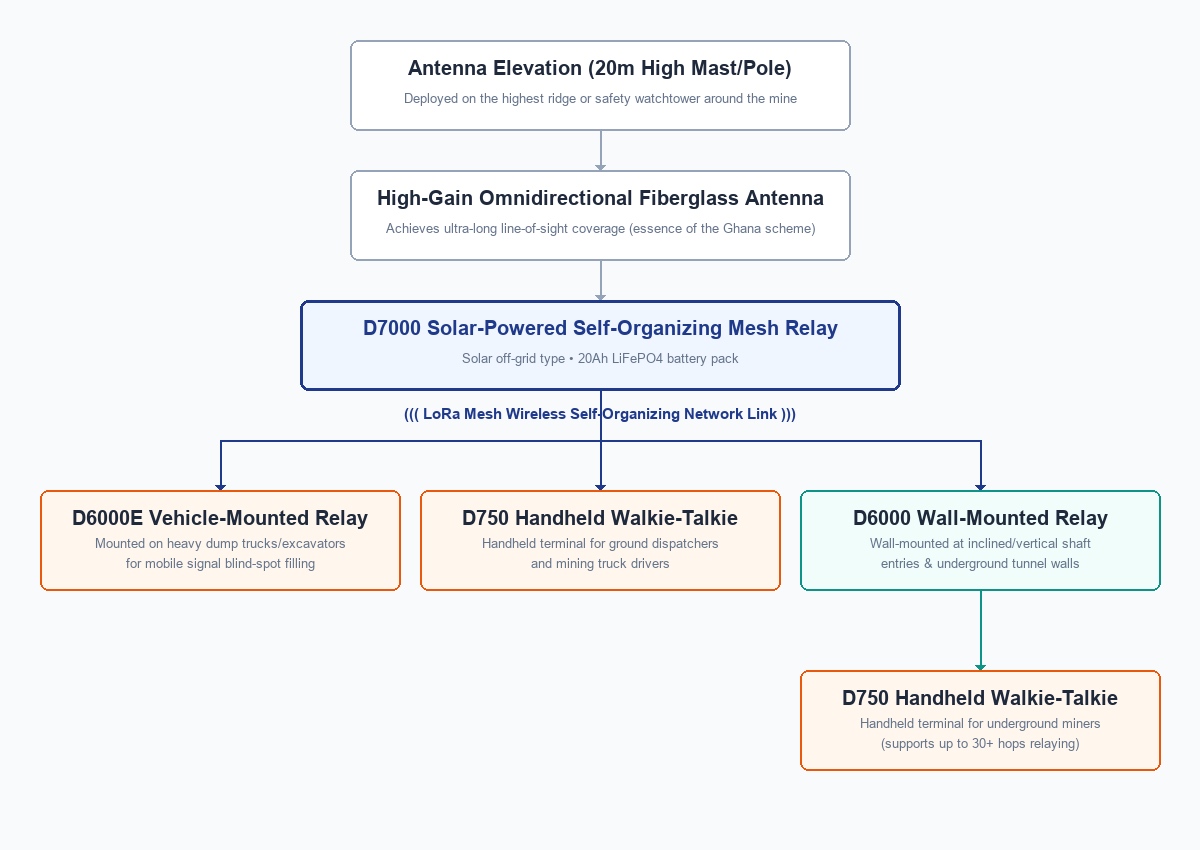
Equipment: D7000 solar-powered self-organizing mesh relay (off-grid).
Position: The highest ridge or a safety observation tower at the rim of the open pit.
Configuration: Industrial-grade 20Ah LiFePO4 battery and high-efficiency solar panel.
Antenna Setup: Using a 20-meter 5D-FB/7D-FB ultra-low-loss coaxial feeder cable, a high-gain omnidirectional fiberglass antenna is mounted on a 15-to-20-meter steel mast or observation tower peak, while the main unit remains low for convenient ground-level maintenance.
Role: Acts as the central backbone node, bridging signals across the surface, pit bottom, and underground shafts.
2. Pit Floor Mobile Chain: “Mobile Command” Nodes
Equipment: D6000E vehicle-mounted intelligent relay and D6000R portable relay.
On-Vehicle Deployment: The D6000E can be installed on heavy-duty mining trucks, such as 100-ton Caterpillar or Komatsu dump trucks, and excavators. The signal moves with the fleet and dynamically covers moving extraction faces.
Temporary Field Deployment: The D6000R portable kit can be placed in high-risk blasting zones or newly dug fronts. Its 18W high power and rugged shockproof shell provide a temporary signal hotspot.
3. Underground Tunnel Chain: “Tunnel Bridges”
Equipment: D6000 wall-mounted fixed relay.
Shaft Entrance: A D6000 is mounted at the shaft entry. One end links wirelessly with the ridge D7000, while the other extends the antenna deep into the shaft.
Tunnel Relay Cascade: D6000 units are mounted on tunnel walls every 500m to 1km and powered by local tunnel mains. The relays cascade signals into the lowest excavation levels.
4. Terminal Execution Layer: “Smart Scout” Walkie-Talkies
Equipment: D750 intelligent self-organizing handheld walkie-talkie (8W).
Users: Truck drivers, miners, dispatchers, and safety inspectors.
Core Technology: Each D750 functions not only as a handheld device but also as a micro-mobile relay node.
Multi-Hop Routing: A D750 signal can hop through tunnel D6000 relays, the entry D6000, and the surface D7000. The case study states support for more than 30 hops (30+ redirects), maintaining voice contact with headquarters from deep underground locations.
|
Comparison Dimension |
KANGLONG LoRa Mesh Solution |
Traditional Brand Solutions |
|
Infrastructure Dependency |
No trenching or cable-laying required. Off-grid equipment can be flexibly located and adjusted. |
Often dependent on wired fiber-optic backbones and fixed high-voltage power supplies. |
|
Deployment Cost |
High cost performance, with no complex engineering construction required. |
May involve network planning, base-station engineering, and substantial construction costs. |
|
Network Survivability |
Self-healing mesh network. If a relay is damaged, the network can reroute through other trucks or handhelds. |
Single-point architectures can isolate subordinate devices when a main base station or cable is damaged. |
|
Ultra-Long Range |
Supports 30+ hops and can be combined with high-elevation antenna deployment. |
The case study describes typical systems as supporting only single-hop or two-hop relaying. |
Mine communication should be validated in physical environments. To verify how the solution adapts to a specific mine topology, the case study recommends starting with the following original test kits:
“Surface Iron Cavalry” Test Kit: Three D750 handhelds for operators at the pit floor and rim, plus one D6000E vehicle relay temporarily mounted on a heavy dump truck to test mobile blind-spot coverage.
“Air-to-Ground” Full-Link Kit: One D7000 solar off-grid relay with a 20-meter coaxial cable, mounted on the highest tower to verify high-elevation antenna down-projection; three D750 handhelds; and one D6000 fixed relay at the shaft entrance to verify underground-to-surface bridging.
Protect mine operations with a high-performance, resilient, and cabling-free communication network built for real-world mining security!
The following FAQ is supplemented from the case study for customer discussions and preliminary solution evaluation. Final coverage, mounting, power, and compliance arrangements should be confirmed through an on-site survey and deployment test.
1. What mining scenarios is this solution designed for?
It is designed for large-scale coal mines that combine open-pit and underground operations, where deep pits, rock walls, complex tunnels, moving equipment, and damaged infrastructure can create communication blind spots.
2. How does the solution bridge open-pit and underground areas?
The proposed Air-Ground-Tunnel architecture uses a high-elevation D7000 backbone node, D6000 relays at the shaft entrance and along tunnel walls, mobile D6000E/D6000R relays in the pit, and D750 handhelds at the user layer. Together, these nodes form a multi-hop mesh path between the pit floor, surface headquarters, shaft entrance, and underground work areas.
3. Why mount the antenna high above the ground?
A high mounting position improves line of sight over the pit and reduces obstruction from mine walls and terrain. In the proposed design, a 20-meter low-loss feeder cable allows the antenna to be mounted on a 15-to-20-meter mast or observation tower while the D7000 main unit remains accessible at ground level.
4. Can the D7000 operate without grid power?
The case study specifies the D7000 as a solar-powered, off-grid relay with an industrial-grade 20Ah LiFePO4 battery and a high-efficiency solar panel. Actual autonomy depends on local solar conditions, equipment configuration, and operating conditions and should be validated on site.
5. How does the network respond if a relay is damaged by blasting or mining activity?
The architecture is designed as a self-healing mesh. If a relay is damaged, the network can seek alternative routes through other available relays, mining vehicles, or handheld devices rather than relying solely on one fixed base station.
6. What is the role of the D6000E vehicle-mounted relay?
The D6000E extends coverage by moving with heavy-duty mining trucks or excavators. This makes it suitable for dynamic extraction faces where the work location changes and fixed coverage may not follow the fleet.
7. When should the D6000R portable relay be used?
The D6000R is intended for temporary deployment in newly dug fronts, or other areas that need a short-term signal hotspot. The case study highlights its 18W high power and rugged shockproof shell.
8. How are underground tunnels covered?
A D6000 can be installed at the shaft entrance, with additional D6000 fixed relays mounted on tunnel walls every 500m to 1km and powered by local tunnel mains. The relays cascade the signal toward lower excavation levels. The exact spacing must be adjusted after testing the tunnel geometry and radio environment.
9. Can handheld radios also help extend the network?
Yes. The D750 is described as both an intelligent handheld walkie-talkie and a micro-mobile relay node. Its multi-hop routing allows signals to pass through available mesh nodes, and the case study states support for more than 30 hops.
10. Who can use the D750 handhelds?
The case study identifies truck drivers, miners, dispatchers, and safety inspectors as primary users. The same device layer can support coordination between mobile crews and headquarters, subject to the final deployment plan.
11. What is the recommended first step before a full deployment?
Start with a physical field test. The case study recommends either the Surface Iron Cavalry Test Kit for pit-floor and mobile blind-spot testing, or the Air-to-Ground Full-Link Kit for validating the high-elevation backbone and underground-to-surface bridge.
12. Does the case study guarantee zero blind spots at every mine?
No. It presents a design approach intended to reduce and bridge blind spots by combining high-elevation antennas and multi-hop mesh relays. Actual performance depends on mine topography, tunnel layout, antenna height, equipment placement, interference, power availability, and local operating conditions. A site survey and field test are required before finalizing the network.
13. Does this solution require trenching or a fiber-optic backbone?
The proposed LoRa mesh architecture is designed to minimize infrastructure dependency and does not require trenching or cable-laying for the wireless relay links. The underground D6000 relays described in the case study use local tunnel mains for power, while the high-elevation D7000 is solar powered.
14. What information is needed for a detailed mine communication plan?
A preliminary design should consider the mine layout, pit depth and rim elevations, shaft and tunnel locations, tunnel lengths and turns, available towers or masts, vehicle routes, power sources, blasting zones, expected users, and the areas where communication failures currently occur.
 English
 عربي
عربي Русский
 Français
 Español
 Deutsch