 English
 عربي
عربي Русский
 Français
 Español
 Deutsch
Experience superior clarity and rugged reliability with the DM-900UV, a 10W dual-band DMR radio featuring IP68 waterproofing and 300-hour voice recording.
Read More

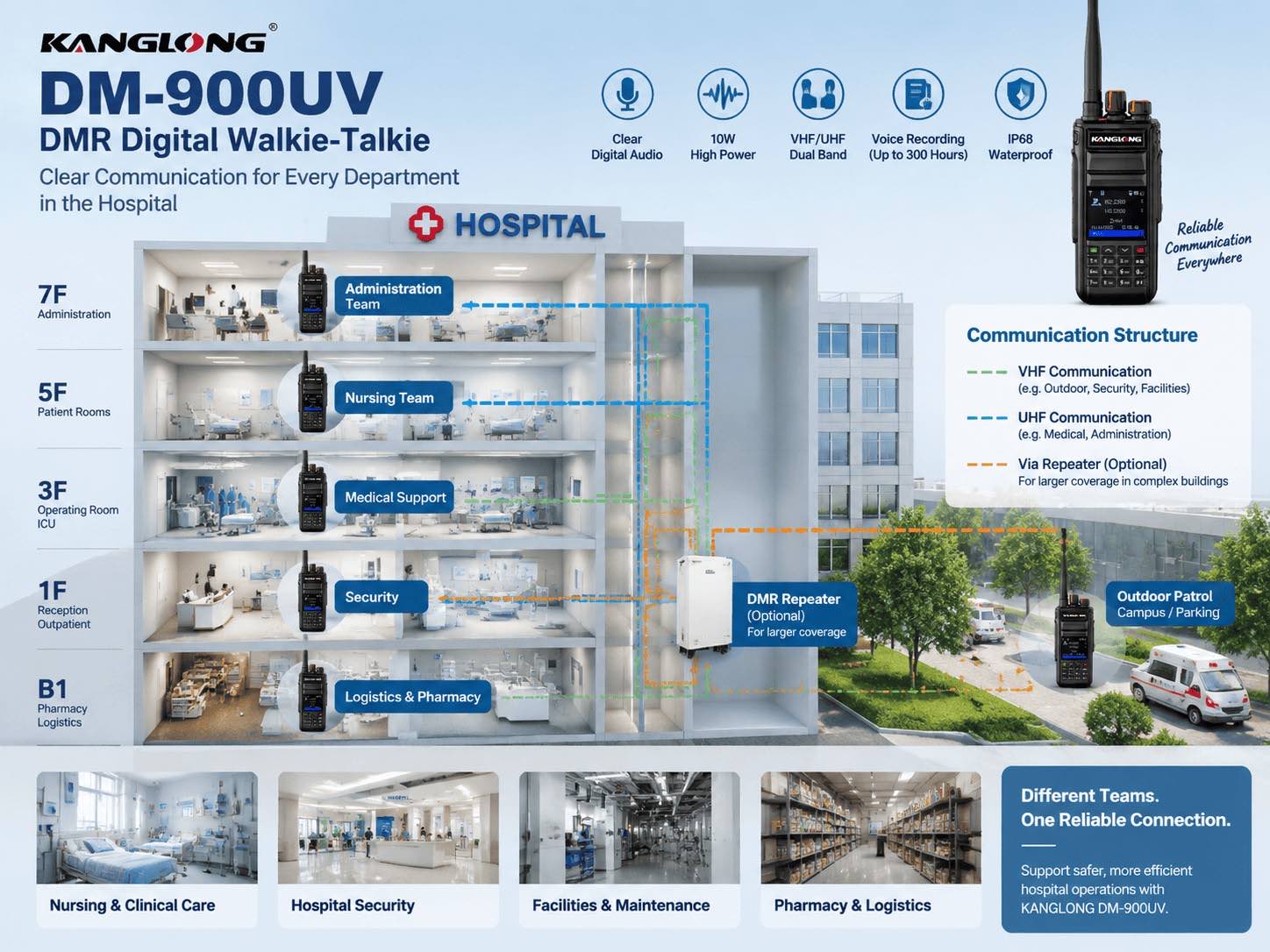
DMR Digital Radio Communication Solution for Hospitals
Hospitals are one of the most demanding environments for professional radio communication.
The challenge is not simply about communication distance. Multi-story concrete structures, underground areas, shielded rooms, multiple departments, noise-sensitive patient areas, and strict cleaning requirements all create unique demands for a reliable two-way radio system.
For hospitals, wireless communication needs to be clear, reliable, easy to operate, and suitable for demanding daily use.
A typical hospital may include multiple floors of reinforced concrete, underground service areas, radiology or MRI rooms with shielding, and other areas where radio signals can be affected.
These areas may still need real-time communication between security, engineering, logistics, and other teams.
A reliable hospital radio system therefore requires a combination of radio performance, frequency planning, and appropriate repeater coverage.
Hospitals often have several communication groups operating at the same time:
Clinical & nursing teams
Security & patient safety
Facilities & engineering
Patient transport & support staff
Putting everyone on the same channel can quickly lead to unnecessary radio traffic and make important messages harder to hear.
Proper channel and talk-group planning helps keep communications organized and reduces interference between departments.
In a hospital, unnecessary radio noise is more than an inconvenience.
Patients may be resting or recovering nearby, so clear digital audio and controllable volume are particularly important. Features such as digital audio processing and tail-tone elimination can help create a quieter communication environment.
Hospitals may need to review communications related to security incidents, equipment problems, operational disputes, or other important events.
Having recorded radio communications can provide a useful reference when reconstructing what happened and when, rather than relying entirely on staff recollection.
Radios used across different departments or shared between shifts may require frequent surface cleaning.
The radio housing therefore needs to withstand demanding daily use while helping prevent dust and water from entering the device.
Hospitals typically need to address five practical challenges:
1. Coverage Blind Spots
How can communication reliability be improved in underground areas, parking facilities, and multi-story buildings?
2. Cross-Department Frequency Planning
Can different departments operate on separate communication channels without purchasing and maintaining completely separate radio systems?
3. Communication Traceability
Can important radio conversations be recorded and reviewed with an accurate timeline when an incident occurs?
4. Hygiene & Cleaning Requirements
Can radios withstand frequent cleaning during daily hospital operations without compromising their internal components?
5. Ease of Operation During Emergencies
Can staff quickly change channels or activate an emergency function without navigating complicated menus?
For hospital security, engineering, facilities, and logistics teams, the KANGLONG DM-900UV provides a professional DMR communication option designed for demanding working environments.
Key specifications include:
10W high-power output
VHF/UHF dual-band operation
DMR digital communication
IP68 dust and water protection
Up to 300 hours of voice recording
Type-C interface
Lone Worker function
DCDM dual-slot communication
Tail Tone Elimination
Programmable side keys
Dedicated emergency function
Coverage Challenges → 10W DMR Output
The DM-900UV uses a 10W high-power design to provide stronger transmission capability than typical low-power handheld radios.
Combined with DMR digital technology, it can provide clearer voice communication within the effective coverage area, making it suitable for security patrols, facility maintenance, and logistics coordination.
Flexible Department Communication → VHF/UHF Dual Band
The DM-900UV supports both VHF and UHF operation, giving hospitals greater flexibility when planning their radio network.
Different teams can be assigned separate channels, talk groups, and communication parameters to keep clinical, security, engineering, and other communications organized.
Communication Traceability → 300-Hour Voice Recording
Built-in storage allows transmitted and received voice communications to be recorded for later review.
This can provide useful communication records for incident investigation, equipment issues, or operational coordination.
Cleaning & Environmental Protection → IP68
The sealed IP68-rated housing provides protection against dust and water, helping the radio withstand demanding working environments and routine surface cleaning.
Hospitals should still verify compatibility between their specific disinfectants and the radio's housing materials.
Emergency Operation → Physical Controls & Emergency Function
A physical channel selector and dedicated emergency function make frequently used controls easier to access.
This helps reduce the amount of training required when staff need to operate the radio quickly under pressure.
Hospitals operate around the clock, and staff may work across multiple shifts.
The DM-900UV features a Type-C interface for programming and data connection, providing a more flexible option for daily operation and maintenance.
Some hospital areas, such as oxygen stations, electrical rooms, underground storage areas, and other relatively isolated locations, may require additional personnel safety measures.
With Lone Worker Mode, if a user does not perform an operation within a preset period, the radio can issue an alert to the dispatch center.
This can help the team identify situations where an employee may require assistance.
When multiple departments share limited radio resources, channel congestion can become a problem.
The DM-900UV supports DCDM technology, enabling two independent communication paths on a single frequency.
This allows different teams to share radio resources more efficiently and can improve dispatch efficiency in busy environments.
The DM-900UV incorporates digital tail-tone elimination technology to reduce unwanted noise at the end of transmissions.
This is particularly useful in quiet areas such as patient wards, where unnecessary radio noise should be minimized.
Two programmable side keys allow frequently used functions to be customized according to the hospital's workflow.
Functions such as group calling or emergency alerts can be assigned for faster access.
With a lightweight design of approximately 325 g, the radio can also be operated with one hand when required.
Hospitals considering a radio system upgrade often ask whether DMR is worth the additional investment compared with a basic analog system.
For hospital environments, there are two important advantages.
DMR uses digital error-correction technology to maintain clear voice quality within the effective decoding range.
Unlike analog communication, where noise gradually increases as the signal becomes weaker, digital communication can maintain clearer audio until the signal reaches its decoding threshold.
However, digital coverage can drop more abruptly once the signal falls below that threshold. For this reason, proper frequency planning and repeater coverage remain important when designing a hospital radio network.
Voice recording provides a communication record that can support incident review and operational documentation.
For smaller healthcare facilities with simple coverage requirements and limited audit needs, analog radios may still be a practical option.
For medium-sized and large hospital campuses, however, the additional capabilities of DMR can make the investment worthwhile.
The KANGLONG DM-900UV is a commercial-grade DMR two-way radio, not a certified medical device.
It does not carry hospital-grade EMC certification for use immediately adjacent to MRI equipment or certain sensitive medical monitoring equipment.
Before deployment, hospitals should have their biomedical engineering or facilities teams evaluate which areas are appropriate for radio use.
As with any RF transmitting device, particular attention should be paid to areas containing sensitive electronic equipment.
With appropriate frequency planning and coverage design, a DMR radio system can help hospitals improve daily communication in several areas:
Higher-power digital radios combined with appropriate coverage planning can improve communication reliability in complex buildings, including underground and low-coverage areas.
Channel and talk-group planning can separate communications between clinical, security, engineering, and other teams, reducing unnecessary interruptions.
Recorded communications can provide useful information when reviewing important events and preparing incident reports.
The IP68-rated design provides enhanced protection against dust and water, supporting demanding daily operation.
Actual cleaning performance will depend on the disinfectants used and their compatibility with the radio housing materials.
No. The DM-900UV is a commercial-grade DMR two-way radio and is not a certified medical device.
Hospitals should have their biomedical engineering or facilities teams determine which areas are suitable for radio use.
Any active RF transmitting device may present a potential interference risk near sensitive electronic equipment.
Hospitals should follow their own EMC policies and conduct an appropriate site-specific assessment before large-scale deployment.
The DM-900UV supports both VHF and UHF operation.
This provides greater flexibility when designing communication channels for different departments and operational areas.
The radio has built-in storage for recording transmitted and received voice communications.
Recording behavior can be configured according to the communication system and operational requirements.
Hospitals should also consider their own data-retention, privacy, and compliance policies before enabling recording across the organization.
The DM-900UV features IP68 dust and water protection, which improves reliability in demanding environments.
However, IP68 does not mean resistance to every type of chemical disinfectant. Hospitals should verify the compatibility of their specific cleaning products with the radio housing materials.
Our DMR and analog radio models can generally be programmed to operate on the same frequencies as many mainstream radio systems, subject to applicable technical and protocol compatibility.
For an existing hospital radio network, we recommend testing a small number of sample units before a full deployment.
DMR can provide clearer and more consistent voice communication within the effective coverage range and supports functions such as digital talk groups and voice recording.
For small facilities with simple communication requirements, analog radios may still be sufficient. For larger hospital environments, DMR can provide additional operational value.
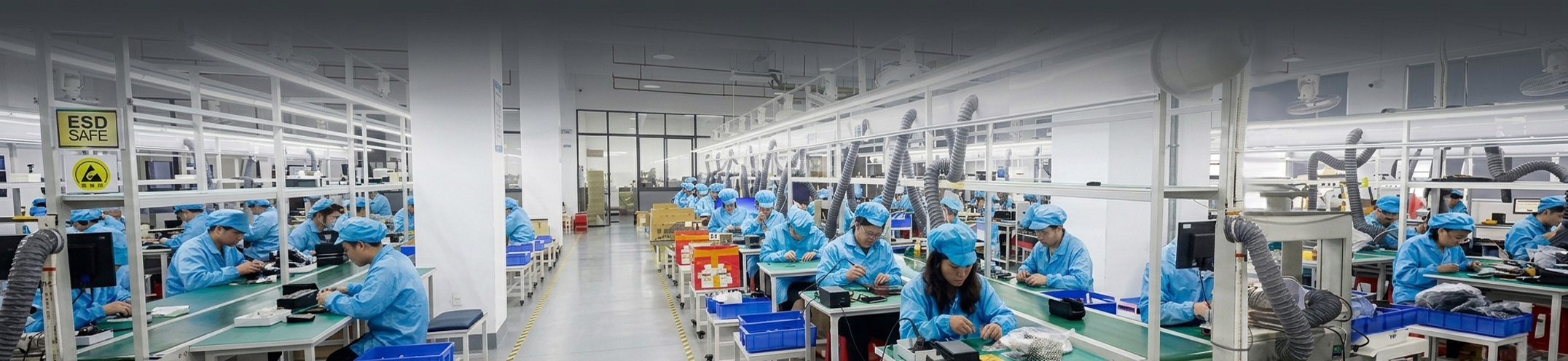
KANGLONG is a professional two-way radio manufacturer based in Quanzhou, China, with more than 20 years of manufacturing experience and an ISO 9001-certified quality management system.
Yes. We provide OEM/ODM services, including logo customization and factory-programmed channels.
Customized branding is available with an MOQ starting from 100 units.
Samples can typically be prepared within 5–15 days.
Bulk orders can generally be shipped within 15 days, depending on order quantity and customization requirements.
KANGLONG is a professional two-way radio manufacturer based in Quanzhou, China, with more than 20 years of experience in radio development and manufacturing.
With advanced SMT production lines and an ISO 9001 quality management system, KANGLONG provides professional wireless communication products and OEM/ODM services to partners in more than 30 countries across security, logistics, large-scale events, and other industries.
Professional Two-Way Radio Manufacturer | KANGLONG
Website: www.kanglongradio.com
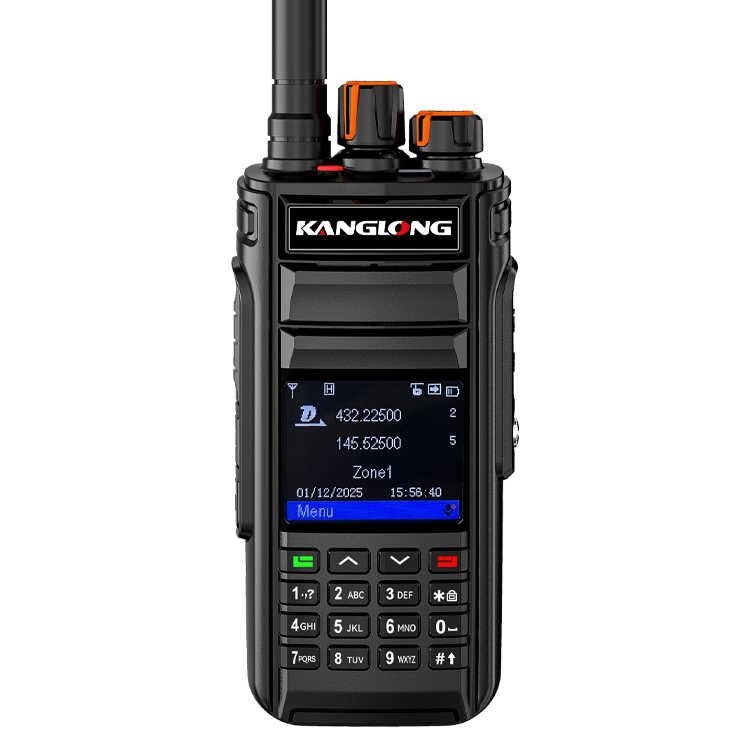
Experience superior clarity and rugged reliability with the DM-900UV, a 10W dual-band DMR radio featuring IP68 waterproofing and 300-hour voice recording.
Read More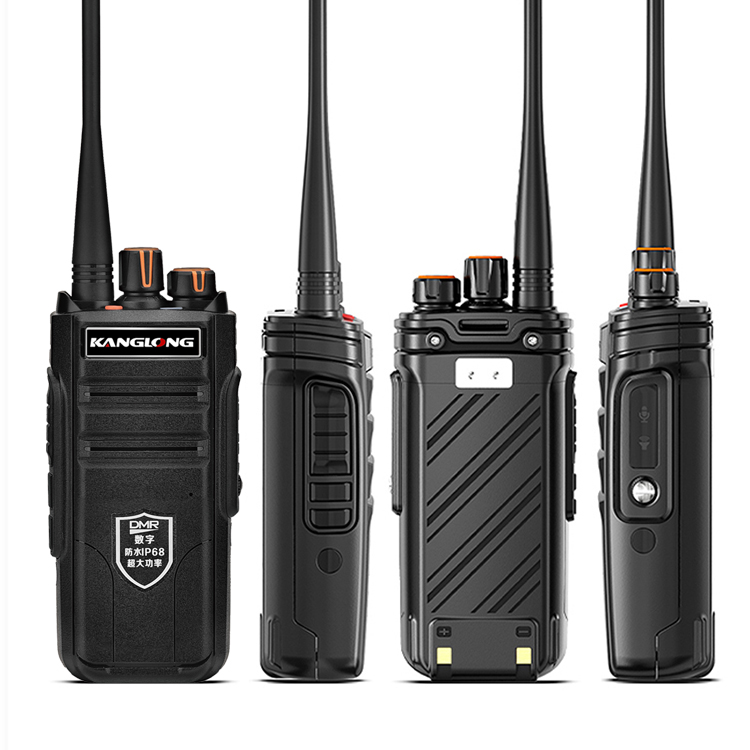
The KANGLONG DM-800 is a professional two-way radio featuring AES256 DMR encryption, 10W walkie talkie power, and same frequency relay radio technology in a rugged IP68 waterproof radio body.
Read More
Ultra-compact and secure, the KANGLONG DM-390 combines professional AES256 digital encryption with a stylish 1.44" color display and Type-C charging, making it the ultimate high-performance communication tool for modern service and outdoor environments.
Read More
Maximize your communication range with the DM-5300 Digital Repeater, featuring 40W high power, TDMA dual time slot technology, and seamless hybrid analog/digital switching for professional radio networks.
Read More