 English
 عربي
عربي Русский
 Français
 Español
 Deutsch
A versatile Android 8.1 4G LTE walkie-talkie featuring high-speed WiFi connectivity, LTE Cat 4 data, and native support for Zello and Smart PTT for seamless global communication.
Read More


Five cities. One radio. How the PZ-56 Android PoC radio keeps a sold-out stadium tour secure.
A portable, platform-flexible communications setup for fast-moving event teams.
bank or a car charger, ensuring zero communication blind spots during their shifts.
The trucks have barely finished unloading. Security needs to be fully online within four hours—in a stadium the team has never worked in, in a country where it has no radio license, with 400 contract guards who have never worked together. What do you do?
This is the reality for many international touring-security teams. They must deploy communications across different cities and venues while keeping hundreds of people coordinated in real time. Every stop brings a new venue, a new local workforce, and a new set of regulations. The requirement that never changes is simple: from doors open to the encore, the team needs live, venue-wide visibility across every gate, backstage route, and section of the floor.
At permanent venues, traditional analog radios and DMR trunking systems remain common. But they were not designed for a touring operation. A venue license can take weeks. Repeater installation requires days of advance setup. And the whole system is difficult to move. For a tour, that model is not just slow—it is impractical.
That is where 4G Android PoC radios fit. Unlike traditional radio systems, a 4G PoC setup does not require a local radio network. If cellular or Wi-Fi coverage is available, the team can be deployed quickly.
Touring security is not just about a large crowd in a large venue. Talk to a tour operations director and the pain points are much more specific:
• No time for local infrastructure. The venue security desk may have only a few hours before doors open. There is no time to install repeaters or coordinate approvals with a local licensing authority.
• Move beyond voice-only communication. When a gate team finds a fake ticket, prohibited item, or distressed guest, “There is a problem at Gate C” is not enough. Location management, dispatch, and data sharing through a PoC platform give the command center a clearer picture.
• Hundreds of guards, one live map. Floor security, perimeter patrols, backstage protection, and parking control run at the same time. The command center needs to know exactly where each unit is—not call into the void and hope someone is near the right gate.
• VIP and artist protection must be mission-critical. The team escorting an artist from the dressing room to the stage cannot afford a dropped connection. Every call on that channel also needs to be recorded for review.
• A new team in every city. Local contractors need to be productive within minutes, not after a full training day. Ideally, they are using an app they already know.
“On tour, you do not get a second chance to build the network correctly. It has to work the first time—in an unfamiliar language, on an unfamiliar network, with noise levels the last venue never had.”
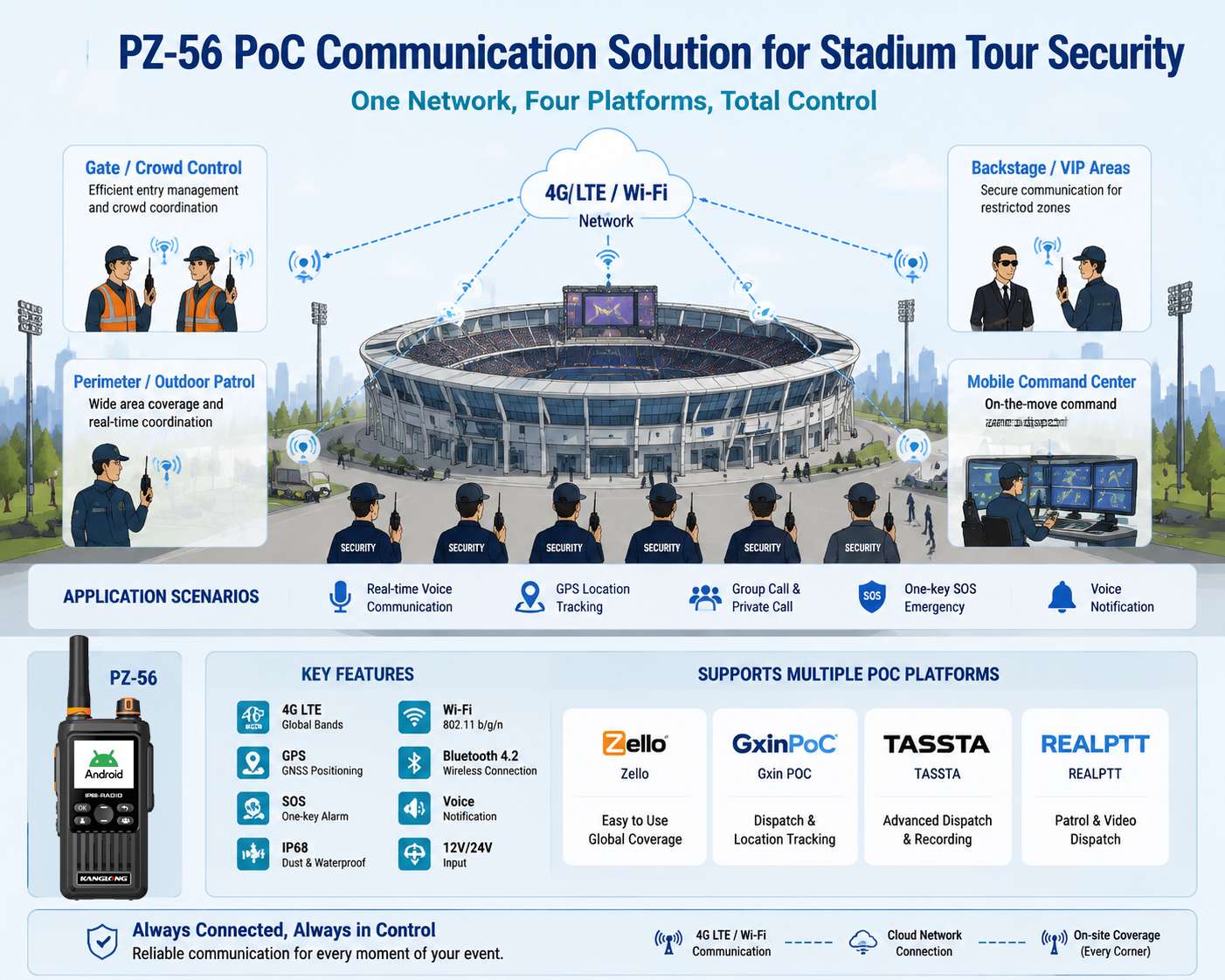
Vanguard’s operations lead does not need four different radios for four different problems. The team needs one hardware platform that can switch between four communications strategies as the project and city change.
That is the core value of the KANGLONG PZ-56 Android PoC radio: one global, multi-band 4G Android terminal that supports major PoC platforms including Zello, REAL PTT, Gxin POC, and TASSTA. It gives each project a flexible deployment path and can work alongside existing radio systems where required.
Platform choice only matters if the hardware can handle the work. Every PZ-56 unit issued for the tour keeps the same factory specification:
• Android 8.1 with global 4G bands. The radio can cross borders with the tour. No country-specific model and no reconfiguration—insert a local SIM and bring the team online.
• GPS, BeiDou, and GLONASS positioning. Combined with a PoC dispatch platform, location data helps managers see where the team is and coordinate the venue more efficiently.
• IP68 dust and water protection. Load-in happens in all weather, and the humidity on a summer show floor is usually tougher than a specification sheet suggests.
• Wi-Fi and Bluetooth 4.2. Wi-Fi provides another network option when cellular conditions change. Bluetooth connects to discreet earpieces used by close-protection teams.
• One-button SOS. A single button sends an emergency alert from the floor or backstage straight to the command center—no channel switching required.
• 12–24V vehicle power. The device supports 12V/24V input for vehicle dispatch and mobile command scenarios.
Vanguard’s touring communications lead follows the same checklist at every stop:
1. Assign radios by role, not by team. Every PZ-56 comes with all four platforms pre-installed. On arrival, the operator only needs to sign each unit into the platform assigned to its work area.
2. Set the day’s geofences. Backstage, VIP routes, and the loading area are defined as virtual boundaries in the dispatch console. If a radio leaves its assigned area, the command center receives an alert.
3. Group channels before doors open. Gates, floor security, and medical each get a dedicated group. The SOS channel stays separate on every platform so emergency alerts are not buried in routine traffic.
4. Run a live SOS and photo test. Before 20,000 guests enter, one device from each area triggers SOS and sends a test photo to the command center. This confirms the full chain is working.
5. Hand over to the local team. The interfaces are familiar to most local staff, so they can get started in minutes instead of spending a full day on rehearsal.
By the third city, communications setup is no longer a variable that needs its own project plan. The command center has a live map of every guard on the floor. A photo of a fake ticket can reach a supervisor in seconds. The artist-protection team works through a dedicated channel and platform controls for more stable, orderly coordination.
When the eleventh stop moves doors open an hour earlier than planned, the floor, perimeter, backstage, and command center are already on the same network. Nothing had to be dismantled, so nothing had to be rebuilt.
That is the real advantage of an open-ecosystem Android PoC radio on the road: it is not a device built for one fixed scenario. It is a flexible communications terminal that adapts to different countries, teams, and operating conditions.
1. Does the PZ-56 require a radio license?
No. The PZ-56 communicates over public 2G/3G/4G cellular networks or Wi-Fi using PoC (push-to-talk over cellular), rather than dedicated radio frequencies. In most regions, that means no venue radio license is required. SIM cards and data services must still comply with local telecommunications rules.
2. What does “four built-in PoC platforms” mean? Can all four run at once?
The PZ-56 comes with Zello, REAL PTT, Gxin POC, and TASSTA pre-installed. Only one platform runs at a time, and users can switch from the home screen. This does not enable cross-platform calling: each platform has its own accounts and network.
3. Can it work on Wi-Fi without a SIM card?
Yes. All four platforms use standard internet data. The PZ-56 can work over Wi-Fi without a SIM or mobile data plan—for example, indoors, at a fixed venue, or during device testing.
4. What is the PZ-56’s actual communication range?
There is no fixed radio-radius limit in the traditional sense. Because it runs over cellular or Wi-Fi networks, it can communicate wherever the network is available—across a city, a country, or borders.
5. Can it communicate directly with DMR or analog radios?
No. The PZ-56 is an Android device running on an IP-based PoC platform, so it cannot directly interoperate with traditional DMR or analog systems. Our PG-60 dual-mode radio can provide a gateway for communication with analog radios.
6. Which of the four platforms should a project choose?
It depends on the use case. Zello is suited to global, easy-to-learn general use. REAL PTT fits enterprise dispatch, patrol, and video workflows. Gxin POC is designed for overseas projects that need an integrated platform-and-hardware delivery. TASSTA fits government and public-safety projects that require certification and recorded call history. All four run on the same device, so the choice can change later without replacing the hardware.
7. Can the PZ-56 work where there is no cellular signal?
No. Unlike LoRa Mesh devices, the PZ-56 depends on cellular data or Wi-Fi because PoC communication is delivered over the internet. It will not connect in a coverage dead zone, such as a deep basement or remote wilderness. For those environments, use a Mesh network or traditional radios as a backup.
8. Does IP68 mean the device is completely waterproof in every situation?
No. IP68 means dust protection and resistance to water immersion under defined test conditions. It is not intended for prolonged submersion or extreme temperatures. It is suitable for normal outdoor use and light rain or splashes, but it should not be treated as a diving device.
9. Can other apps be installed?
Yes. The PZ-56 runs Android 8.1 and can install compatible apps as needed, including other PTT tools and office or dispatch applications. This open Android ecosystem is one of its advantages over closed, single-platform PoC radios.
10. How do platform accounts and fees work?
Each platform is operated and billed separately. Zello, REAL PTT, Gxin POC, and TASSTA each have their own account system, pricing model—free, subscription, or project-based—and terms of service. Buying the PZ-56 does not include a platform subscription. Activation must be arranged separately with the platform provider or a KANGLONG channel partner.
Note: Actual network performance, platform features, and pricing depend on local cellular coverage, data plans, regional regulations, and each platform’s current policies. Final project configuration should follow the target market’s regulatory requirements and on-site testing.
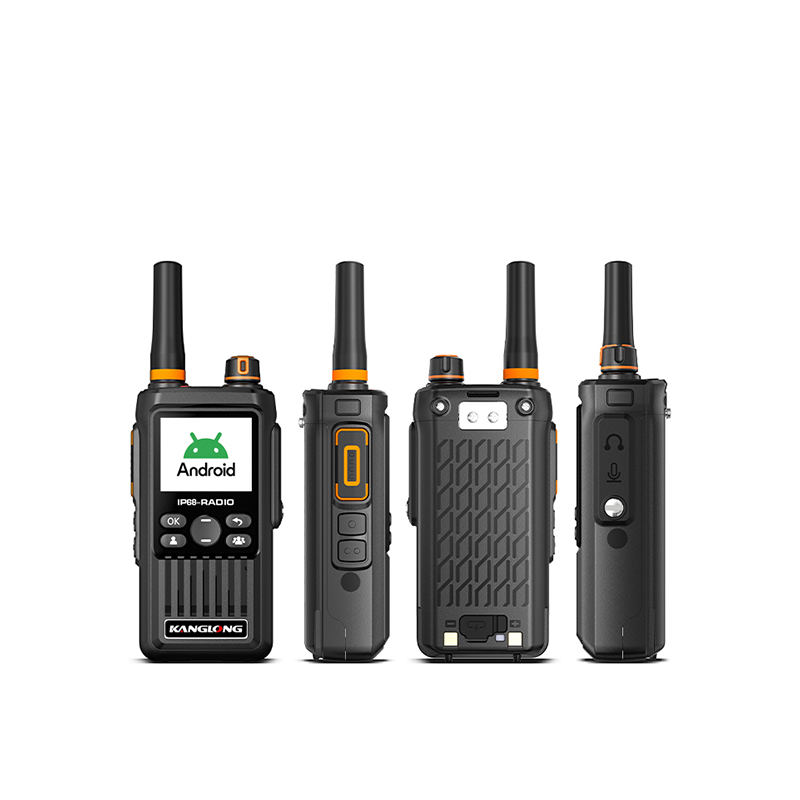
A versatile Android 8.1 4G LTE walkie-talkie featuring high-speed WiFi connectivity, LTE Cat 4 data, and native support for Zello and Smart PTT for seamless global communication.
Read More