 English
 عربي
عربي Русский
 Français
 Español
 Deutsch
The D-7000 is a maintenance-free, solar-powered LoRa mesh repeater featuring a 20Ah high-capacity battery and 30-level signal jumping for permanent off-grid network coverage.
Read More


Overview:
How KANGLONG Solar-Powered Ad-Hoc Mesh Networking eliminates communication blind spots, keeps remote patrol teams connected, and ensures rapid fire response across rugged terrain.
Fire prevention communication is an interconnected workflow. Any latency or packet loss directly reduces emergency response efficiency.
Zero Cellular Coverage
Deep valleys, dense canopies, and remote peaks lack cellular infrastructure, leaving standard mobile devices useless.
Severe Terrain Obstruction
Mountains and ridges block RF Line-of-Sight (LOS), disconnecting teams even a few hundred meters apart across a ridge.
High Maintenance & Power Barriers
Mountain-top repeaters lack commercial AC power; manual battery swapping and fuel logistics are costly and dangerous.
Harsh Operational Climate
Sub-zero morning temperatures, heavy rain, dense fog, and extreme afternoon heat test device durability.
Single Point of Failure
Traditional single-repeater systems collapse if the central node goes down, cutting off all teams within that sector.
The KANGLONG D-7000 is an all-in-one solar-powered Ad-hoc mesh repeater engineered specifically for off-grid forestry and rugged terrain deployments.
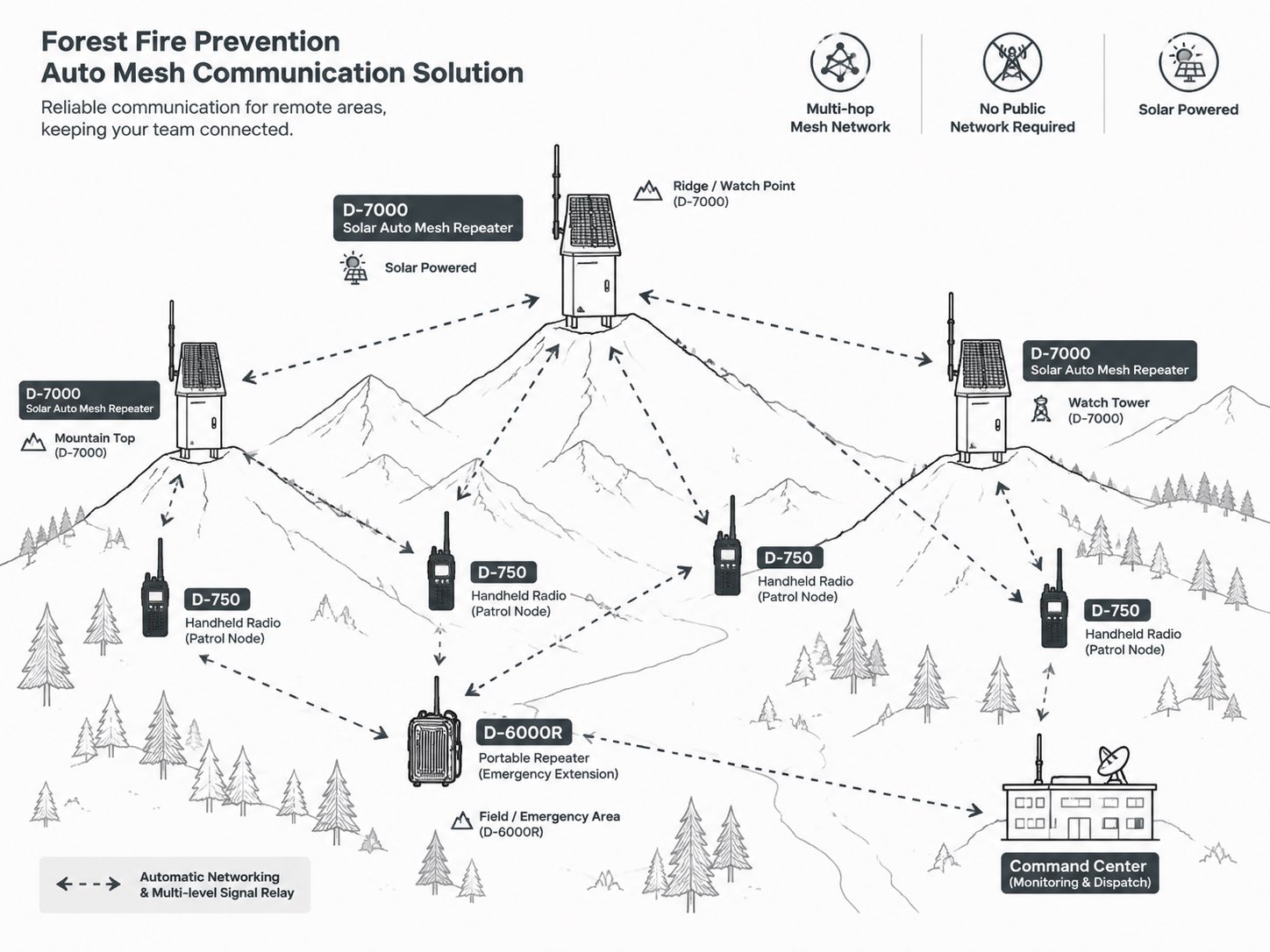
D7000 · Solar Base Repeater (20W, 20Ah LiFePO4)
High-altitude strategic peaks and observation towers for primary area-wide coverage.
D750 · Rugged Handheld (8W, IP68 Waterproof)
Ground rangers and foot patrol personnel requiring mobile all-weather reliability.
D6000R · Portable Tactical Repeater (18W, 10,000mAh)
Rapid deployment backpack unit carried directly to the active fireline.
D6000 · Base Station Repeater (20W, AC Powered)
Fixed ranger stations, base camp HQ, and permanent checkpoints with mains power.
D6000E · Vehicular Mobile Repeater (18W)
Patrol 4WD vehicles and mobile command convoys providing rolling coverage.
System Interoperability Note: The D-Series utilizes a proprietary decentralized mesh protocol. For integration with existing analog or DMR systems, a dual-mode cross-band gateway is deployed.
A: The D7000/D750 operates in the 400–480 MHz UHF professional band. Specific licensing and frequency approvals depend on local radio regulatory authorities. We provide regulatory compliance support during solution planning.
A: Range depends heavily on antenna elevation, terrain profile, and line-of-sight clearance. Open peak-to-peak links reach 10–20 km. Total coverage extends seamlessly by cascading additional mesh nodes.
A: The D7000 charges via solar panels in sunlight and runs on internal 20Ah LiFePO4 storage during overcast days. Autonomous runtime depends on local solar irradiance and daily transmit duty cycle.
A: Yes. The D750, D7000, D6000, D6000R, and D6000E belong to the same mesh ecosystem and interconnect seamlessly.
A: Standard D7000/D750 mesh models prioritize robust voice dispatch without integrated GPS return. For location tracking, GPS-enabled digital/PoC hybrid models or third-party tracking beacons can be integrated.
A: Yes. The D750 features an auto-relay mode for emergency hop extension. When fixed D7000/D6000 repeaters are present, handhelds should stay in standard mode to prevent routing contention.
A: SOS capabilities vary by model. Digital/PoC radios offer dedicated GPS SOS. Please confirm specific SOS requirements with our engineering team prior to ordering.
A: The system utilizes a specialized low-bitrate compression codec tailored for mission-critical dispatch intelligibility. For routine HD voice + off-grid redundancy, a hybrid PoC + Mesh deployment is recommended.
A: Operating range is -20°C to +60°C. The D750 handheld is rated IP68 waterproof/dustproof. The D7000 uses a heavy-duty outdoor weather-resistant chassis with surge/lightning protection recommendations.
A: Open-pit mining, wind farms, agriculture, maritime ports, and disaster emergency rescue—any scenario requiring autonomous, carrier-independent off-grid communications.
Field Verdict
Wildfires won't wait for cellular towers. Solar-powered Ad-hoc mesh technology delivers instant, self-healing connectivity across zero-signal wilderness.
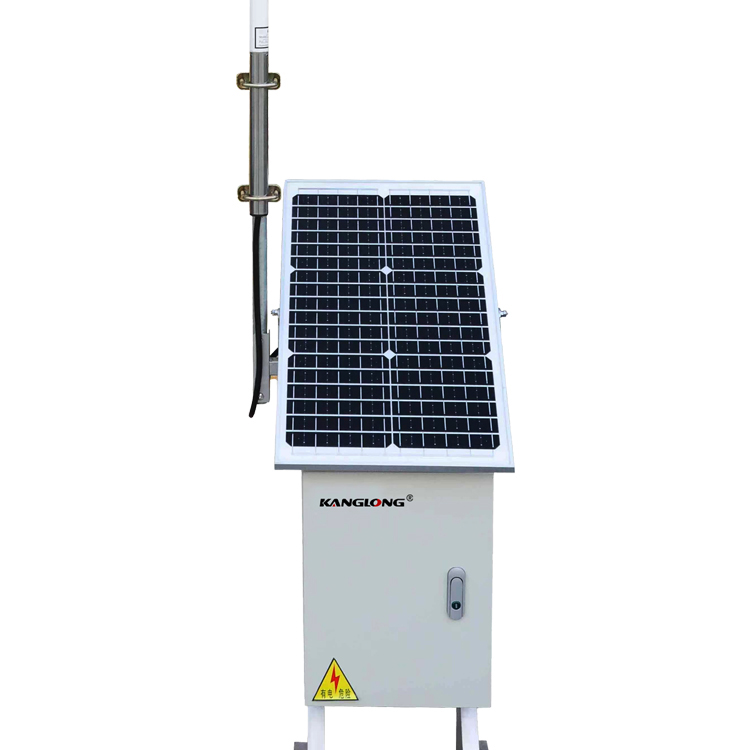
The D-7000 is a maintenance-free, solar-powered LoRa mesh repeater featuring a 20Ah high-capacity battery and 30-level signal jumping for permanent off-grid network coverage.
Read More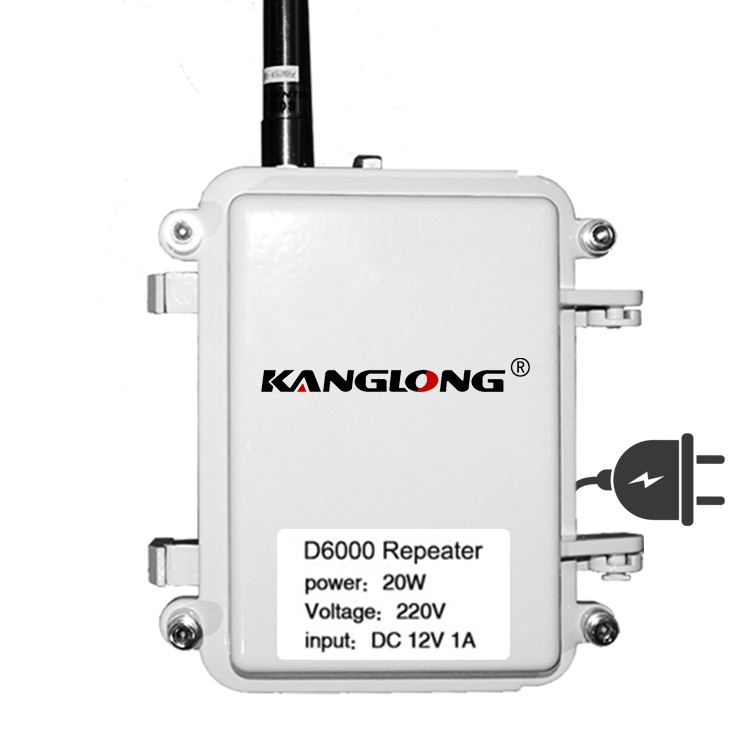
The D6000 is a powerful 20W long-range repeater that builds automatic mesh networks with 30-level signal jumping for total coverage in no-signal zones.
Read More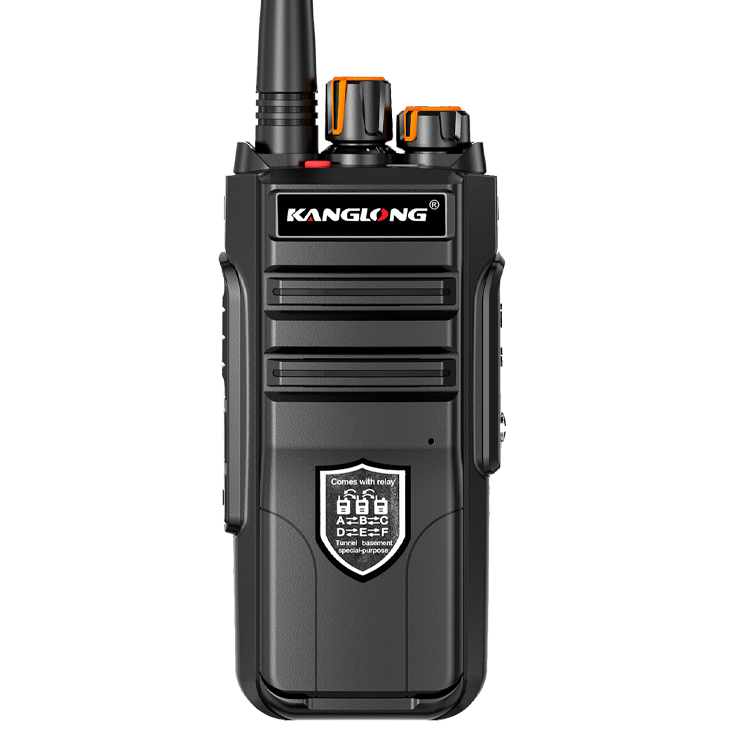
The D-750 Ad-hoc Mesh Radio features a 30-level continuous jump transfer function to extend communication range, providing a reliable 8W high-power signal and IP68 waterproof protection for seamless connectivity in complex tunnel or basement environments.
Read More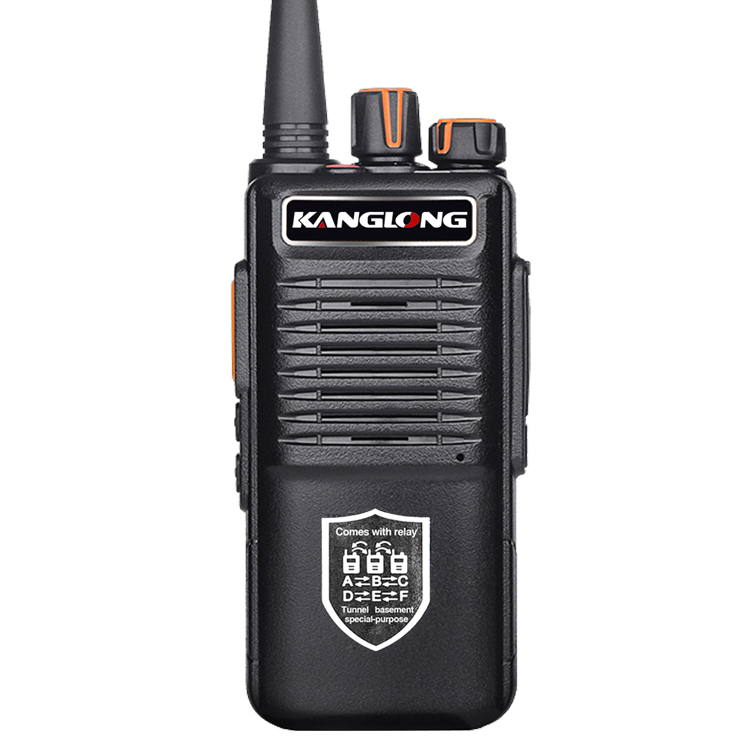
Boost your range with the D-680 5W High-Power Mesh Radio. Features 30-level relay jumping for long-range communication in tunnels, basements, and no-signal environments. Reliable, seamless, and built for complex underground connectivity.
Read More