 English
 عربي
عربي Русский
 Français
 Español
 Deutsch
Through a professional technical team, we provide customers with targeted equipment selection recommendations and comprehensive after-sales services, winning the trust and recognition of customers.



Author
Through a professional technical team, we provide customers with targeted equipment selection recommendations and comprehensive after-sales services, winning the trust and recognition of customers.
An Analytical Executive Review on DMR Tier II Implementation, Long-Range LoRa Mesh Architectures, and Professional OEM/ODM Hardware Standards.
The global landscape of wireless communication is undergoing a profound structural shift. For decades, RF engineering relied on straightforward point-to-point topologies and legacy analog spectrums. However, as industrial complexes expand, high-density metropolitan spaces multiply, and commercial logistics operations scale, the requirements placed on frontline hardware have intensified. Modern telemetry, severe weather anomalies, and high-interference environments demand absolute reliability, spectral efficiency, and multi-tier encryption standardizations. Consequently, stakeholders are re-evaluating their communication frameworks, moving beyond basic voice transmission toward deeply resilient, hybrid physical layouts.
As a global hub for high-performance hardware development, the Quanzhou radio supplier ecosystem continues to spearhead these advancements. Foremost among these innovators is Kanglong Radio (Kanglong Electron. Tech. Co., Ltd.), an established, engineering-driven two-way radio manufacturer with over two decades of R&D history. By closely monitoring deployment data across thirty-plus countries, the industry is witnessing an optimization across three distinct technological fronts: the maturation of Digital Mobile Radio (DMR) Tier II protocols, the integration of long-range LoRa multi-hop auto-mesh topologies, and a renewed emphasis on hyperrugged, high-power physical layers designed for complex deployment architectures.
Analog communication remains invaluable for instantaneous, low-latency loops; however, commercial operations facing limited spectral availability are migrating decisively toward a DMR digital two-way radio standard. Operating primarily under the ETSI DMR Tier II open standard, these systems utilize Time Division Multiple Access (TDMA) 2-slot configurations. TDMA effectively splits a single 12.5 kHz channel into two independent talk paths, doubling traffic capacity without requiring additional frequency licensing or causing channel crowding.
The operational value of this digital transition is best illustrated by the integration of state-of-the-art vocoders, such as the AMBE+2™ audio compression system. Unlike legacy analog circuits that amplify ambient noise alongside human voice, digital vocoders sample speech patterns, filter out predictable environmental frequencies—such as eavy machinery hums, wind shear, and sirens—and reconstruct clear, synthesized voice data at the receiver's end. Furthermore, digital architectures facilitate the integration of 256-bit Advanced Encryption Standard (AES 256) layers directly into the data payload, preventing unauthorized interception across municipal or corporate channels.
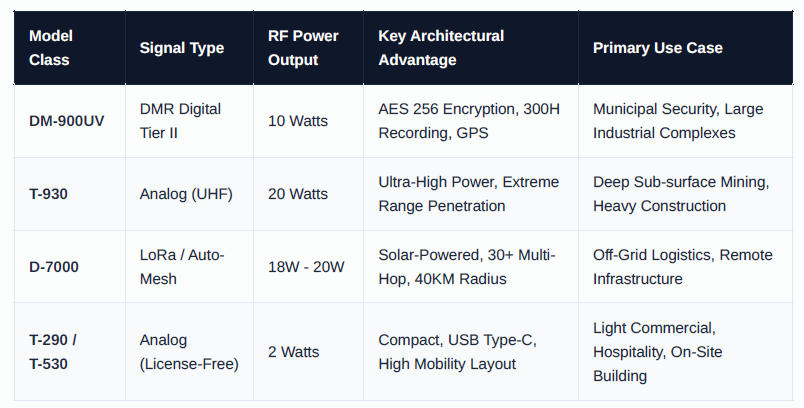
In response to this demand, professional-tier hand-held transceivers have integrated advanced telemetry. The DM-900UV digital walkie-talkie serves as a prime example of this technological class. Featuring a dual-band design (UHF/VHF) and a commanding 10-watt output power rating, the unit leverages a full 1024-channel capacity alongside integrated global positioning systems (GPS) and automatic SOS emergency dispatch sequences. Crucially, modern fleet management demands extensive compliance auditing; the device's 300-hour voice recording capacity ensures all field coordination can be analyzed post-incident. When lower channel densities are required but physical resilience cannot be compromised, units like the 256-channel DM-800 provide an equivalent 10W punch paired with 200 hours of continuous audio archiving, offering logistics and heavy manufacturing teams a balance between data retention and hardware cost.
Technical Deep-Dive: TDMA 2-Slot Spectral Efficiency
By utilizing a 30 ms structure divided into two 15 ms slots, TDMA allows two separate conversations to share a
single RF carrier. This alternating pulse technique also reduces power amplifier duty cycles, translating to a
substantial decrease in battery draw compared to continuous-transmission FDMA or legacy analog systems.
One of the most notable developments in recent wireless communication is the integration of Long Range (LoRa) technology within standalone voice and data relay structures. Historically, expanding the footprint of a localized handheld radio fleet required a heavy investment in tall base-station towers, high-site real estate, or reliance on commercial cellular networks (PoC), which are vulnerable to power outages and congestion during regional emergencies.
The deployment of a modern LoRa wireless solution addresses these constraints through decentralized, self-healing topologies. By embedding built-in auto-mesh relay firmware into ruggedized physical nodes, field equipment can establish independent networks over extensive ranges. These systems operate via a multi-hop architecture (supporting 30+ hops), where each individual repeater dynamically identifies the optimal path to transmit voice packets across rugged geographical terrain or structural blockages, extending effective ranges up to 40 kilometers.
This off-grid paradigm shift is defined by specialized infrastructure hardware:
While digital and mesh networks dominate high-level system upgrades, traditional analog architecture continues to hold a substantial market share. In fast-paced operational environments—such as high-pressure construction zones, maritime container terminals, and emergency tactical response—the absolute zero-latency response of analog remains crucial. The core constraint of traditional analog has always been range degradation and vulnerability to adjacent-channel interference. To mitigate this, manufacturers have focused on high-power walkie-talkie development alongside advanced hardware filtering chips.
Delivering raw power safely through a hand-held chassis requires careful thermal dissipation engineering. The T-930 analog transceiver achieves an industry-leading 20W ultra-high power rating across the UHF spectrum, penetrating reinforced concrete sub-structures and heavy industrial installations where lower-tier units experience signal dropout. To support environments prone to signal overlap, units like the 10W T-790 utilize highly refined conventional chips engineered specifically for high anti-interference thresholds and high receiver sensitivity. Rather than relying on software correction, these physical filters shield the inner receiver from stray RF noise, ensuring clear, intelligible communications even when operating adjacent to high-voltage power lines or heavy machinery transformers.
Beyond internal circuit boards and RF frequencies, corporate procurement managers prioritize long-term field survivability and logistical simplicity. A radio system that requires complex, single-purpose multi-unit charging docks or fails upon contact with water significantly increases the total cost of ownership (TCO) due to downtime and ongoing component replacement.
Consequently, two major hardware requirements have standardly emerged across all tiers of the industry:
This design philosophy is evident across various market segments. For instance, the P860/P-830 series provides 10W analog power protected by a certified IP68 chassis, making it a reliable option for heavy marine or civil engineering projects. For commercial operations seeking entry-level simplicity without compromising ruggedness, the 5W mid-tier P-500, KL-T80, and KL-T86 models leverage market-proven stability and international CE approvals to serve security details and facility management teams reliably.
For global distributors, regional network providers, and security brands, importing off-the-shelf equipment rarely meets all regulatory compliance and market-specific branding needs. Navigating global markets requires hardware verified by strict certification bodies, including CE, FCC, RoHS, and ISO 9001 quality management standards. A failure in design compliance can halt entire shipments at international borders, incurring costly delays.
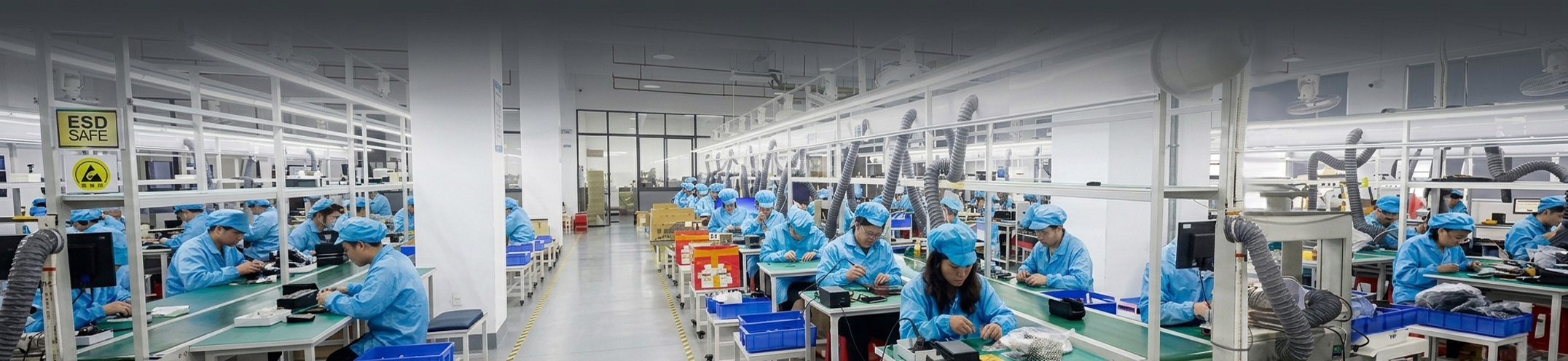
This reality underscores the importance of choosing an experienced partner capable of delivering a comprehensive OEM/ODM walkie-talkie solution. A true manufacturing partner does not simply assemble pre-fabricated plastic components. Industry leaders like Kanglong Radio provide full-service customization beginning at the initial industrial design (ID) phase, moving through internal printed circuit board (PCB) layouts and software optimization, and extending to custom localized packaging and tailored frequency pre-programming. By operating advanced Surface Mount Technology (SMT) production lines and high-precision testing laboratories, these specialized facilities ensure every unit meets tight performance metrics before shipment. This degree of endto-end quality control allows international brands to confidently deploy customized wireless communication equipment tailored precisely to local market demands—whether that means supplying highly flexible, license-free walkie-talkie units (such as the T-288 or T-310) for European retail spaces, or robust, high-capacity fleets for heavy industrial applications.
The core path of professional wireless hardware development is clear: communication infrastructure must remain simple to operate while becoming increasingly sophisticated under the hood. As digital vocoders, autonomous solar-powered LoRa mesh repeaters, and high-power physical layers continue to advance, the boundaries of remote connectivity will expand further. For enterprise clients and global trade partners, aligning with an agile, certified manufacturer is no longer just a procurement choice—it is a foundational business strategy for securing resilient, future-ready communication systems in an interconnected world.