 English
 عربي
عربي Русский
 Français
 Español
 Deutsch
Through a professional technical team, we provide customers with targeted equipment selection recommendations and comprehensive after-sales services, winning the trust and recognition of customers.




Author
Through a professional technical team, we provide customers with targeted equipment selection recommendations and comprehensive after-sales services, winning the trust and recognition of customers.
If you are new to the world of two-way radios, walking into a store or browsing online can feel overwhelming. You’ll see a massive wall of technical jargon: frequencies, channels, analog, digital, DMR, and something called PoC.
Don’t sweat it. Today, we are breaking it all down in plain, everyday English. No confusing tech-speak, no fluff—just what you actually need to know.
Specifically, we are going to talk about a game-changing feature that is taking over the industry: Wi-Fi functionality in PoC radios. By the end of this guide, you’ll know exactly how this technology works, how it solves your biggest daily communication headaches, and how to pick or customize the perfect radio for your needs.
Let’s start with the basics. PoC stands for Push-to-Talk over Cellular.
Think of a traditional walkie-talkie. You press a button, you talk, and your voice travels over radio waves directly to another radio nearby. If you go too far away, the signal drops, and you get nothing but static.
A PoC radio changes the game by acting like a hybrid between a rugged walkie-talkie and a smartphone. Instead of building its own radio network, a PoC radio uses the exact same national 4G/LTE cellular networks that your iPhone or Android phone uses.
In short: If your smartphone has service in that location, your PoC radio will work there too. This means you can talk to someone across the street, across the city, or even on the other side of the country instantly, just by pressing one button.
To understand why PoC radios (especially those with Wi-Fi) are becoming so popular, let’s quickly look at how they stack up against old-school analog and digital radios.
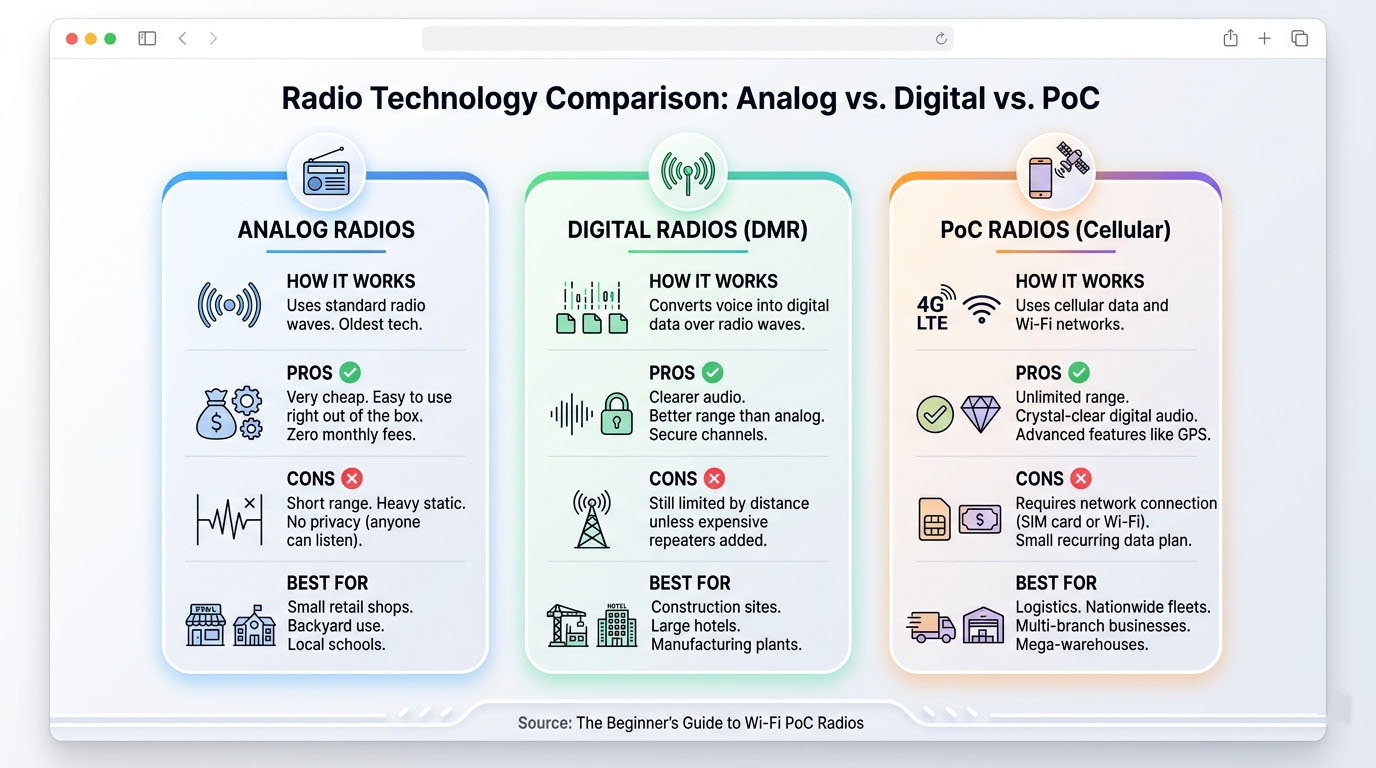
Many standard PoC radios only rely on a cellular SIM card to work. But the newest generation of smart PoC radios comes with built-in Wi-Fi connectivity. Let’s look at how this works.
To make Wi-Fi happen, the radio needs specific components inside its shell:
A Wi-Fi Chipset/Module: A small internal microchip that detects and connects to wireless local networks (2.4GHz or 5GHz bands).
A Dedicated Wi-Fi Antenna: A small, internal antenna optimized to grab wireless internet signals from local routers without interfering with the regular cellular or GPS antennas.
When your radio has Wi-Fi, it doesn't just look for cell towers. It continuously scans for trusted wireless routers.
When you press the Push-to-Talk (PTT) button, your voice is converted into tiny packets of internet data. If the radio is connected to Wi-Fi, it sends those data packets through the local office router, up into the cloud server, and instantly down to your team’s radios.
If you buy a PoC radio without Wi-Fi, you are 100% dependent on your cellular carrier. If you step into a spot with no cell phone reception, your radio becomes an expensive paperweight. A Wi-Fi-enabled PoC radio gives you a reliable, seamless backup network.
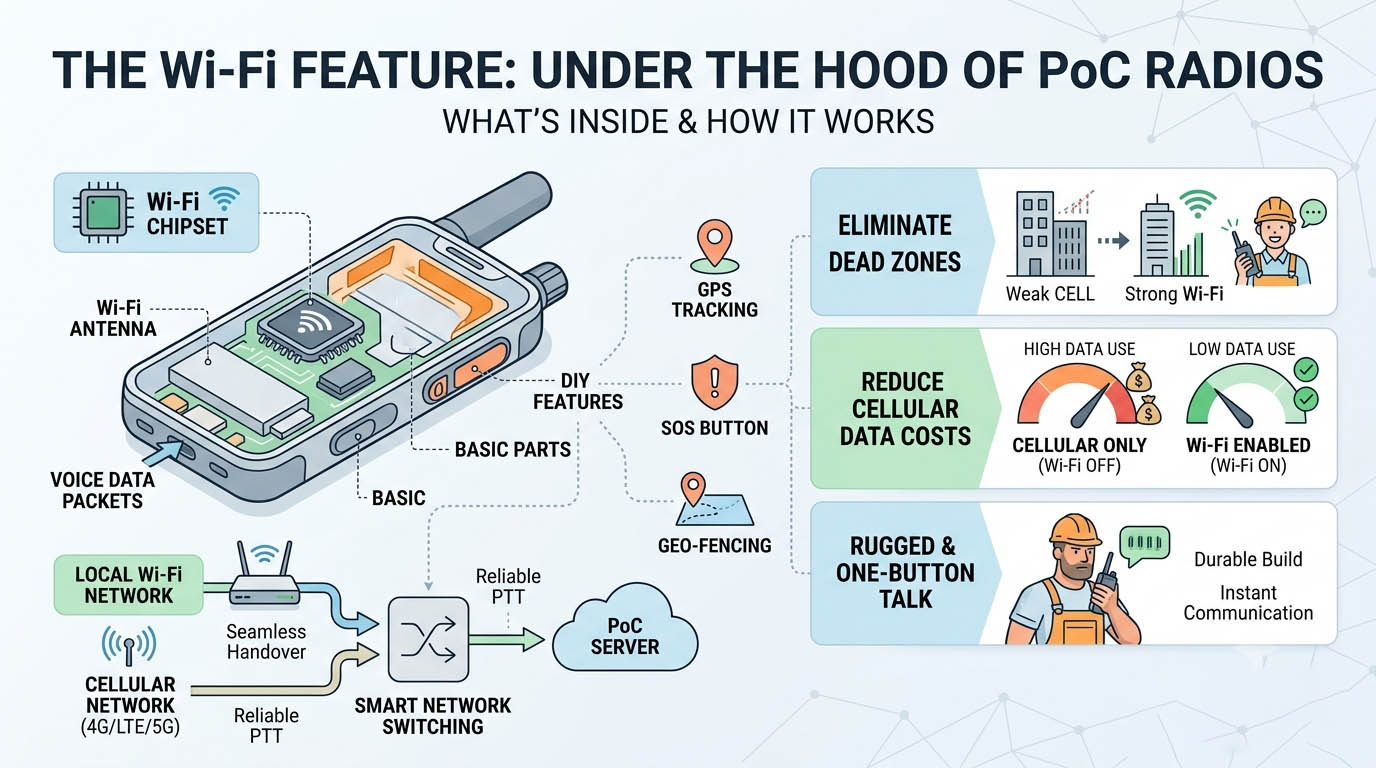
Let’s talk about real life. If you run a team or manage a facility, you probably run into the same communication headaches over and over. Here is how a Wi-Fi-enabled PoC radio solves them directly.
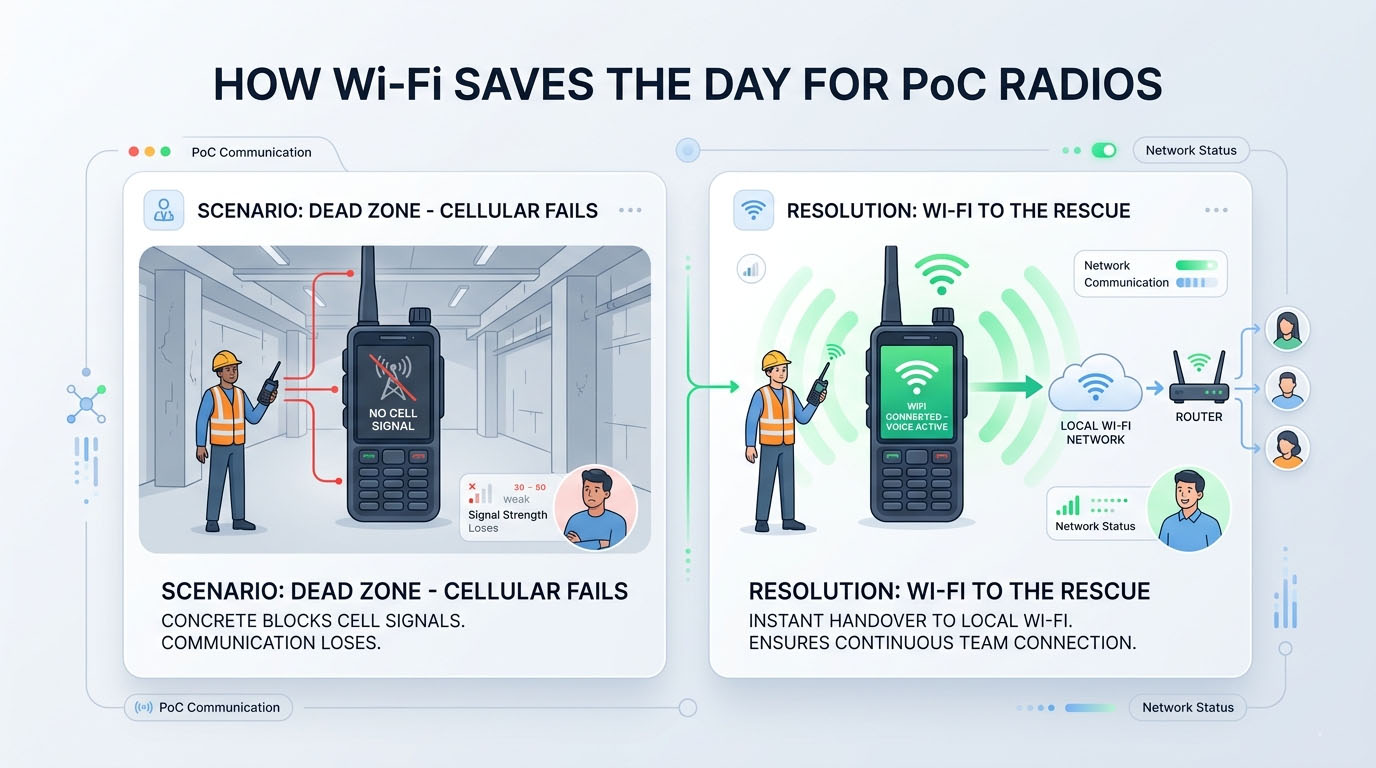
The Problem: You run a large hotel, a subterranean parking garage, or a sprawling concrete warehouse. As soon as your team steps into the basement or the center of the building, the cellular signal drops to zero. Standard PoC radios stop working.
The Wi-Fi Solution: You don’t need a cell signal if you have building Wi-Fi. The radio automatically hooks into your local wireless network. Your security team in the deep basement can talk flawlessly to the front desk on the top floor.
The Problem: You have 50 workers talking all day long. If they use cellular data every single second, your monthly carrier bill is going to hurt.
The Wi-Fi Solution: When workers are inside your facility, the radios route all voice data over your free, existing office Wi-Fi. You save your cellular data allotment for when your drivers or field workers actually leave the building.
The Problem: You need coverage across a massive corporate campus, but traditional digital radios won't stretch that far without buying, installing, and licensing a $5,000+ repeater tower on the roof.
The Wi-Fi Solution: Skip the tower and the FCC paperwork. If your campus already has outdoor or indoor Wi-Fi access points, your PoC radios can use that existing network to cover every single square inch for free.
While we are talking about wireless features, let's briefly mention Bluetooth.
When a PoC radio has built-in Bluetooth, it allows you to pair the device with wireless accessories—just like pairing your phone with your car or your wireless earbuds.
This is a massive safety and convenience upgrade. Security guards can use discrete, hidden wireless earpieces. Heavy machinery operators or drivers can use wireless rings or remote PTT buttons attached to their steering wheel, keeping their hands completely free and their eyes on the road.
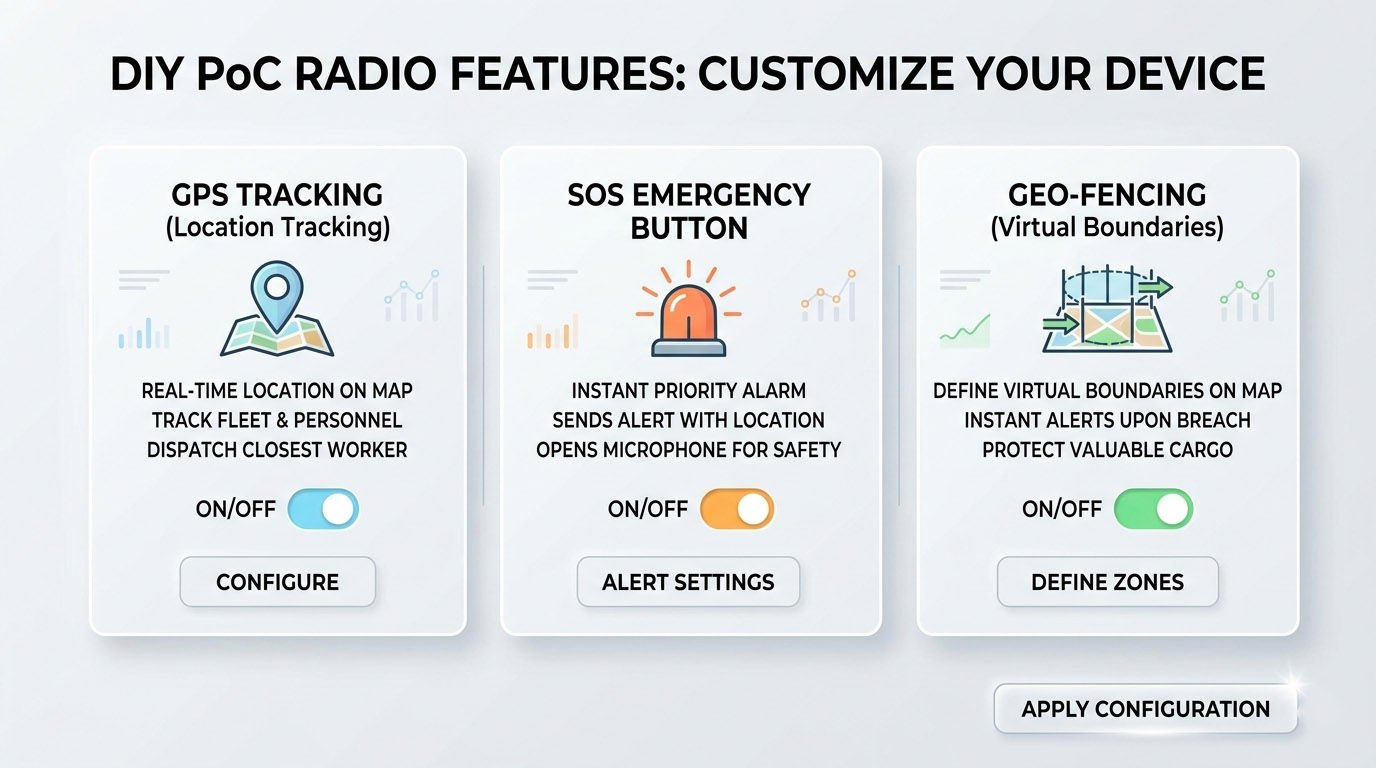
One of the coolest parts of modern PoC radios is that they are highly customizable. You don't have to use every feature, but you can turn them on or off based on your specific industry needs. Think of it like building your own custom communication tool.
What it does: Tracks exactly where the radio (and the worker holding it) is located in real-time on a digital map.
Who needs it: Fleet managers, delivery companies, and large campus security teams who need to dispatch the closest worker to an incident.
What it does: A bright, easy-to-find physical button on the radio. When pressed for a few seconds, it sends an instant, high-priority emergency alarm to the dispatcher or the whole team, opening up the microphone so everyone can hear what's happening.
Who needs it: Lone workers, night-shift security guards, or anyone working in high-risk environments.
What it does: Allows a manager to draw a virtual "fence" or boundary on a digital map. If a worker carries the radio outside of that designated area (or enters a restricted zone), the system instantly alerts the manager.
Who needs it: Logistics companies protecting high-value cargo, construction sites keeping workers out of hazardous areas, and equipment rental businesses.
Let’s look at some of the popular options available right now for buyers looking for Wi-Fi and Bluetooth capabilities.
The Good: Extremely rugged, built like a tank, sleek design with a hidden screen that won't crack easily. Great brand reputation.
The Bad: Very expensive upfront cost, and it locks you tightly into Motorola’s ecosystem and specific subscription platform.
Verdict: Great if you have a massive enterprise budget and need ultimate physical durability.
The Good: Compact size, very loud 3-watt speaker with great noise reduction, excellent battery life.
The Bad: The screen interface is a bit basic, and accessories can be hard to source quickly.
Verdict: A solid, mid-range workhorse radio for noisy environments.
If you want something modern, highly cost-effective, and incredibly easy to carry, you need to look at what Kanglong brought to the table this year.
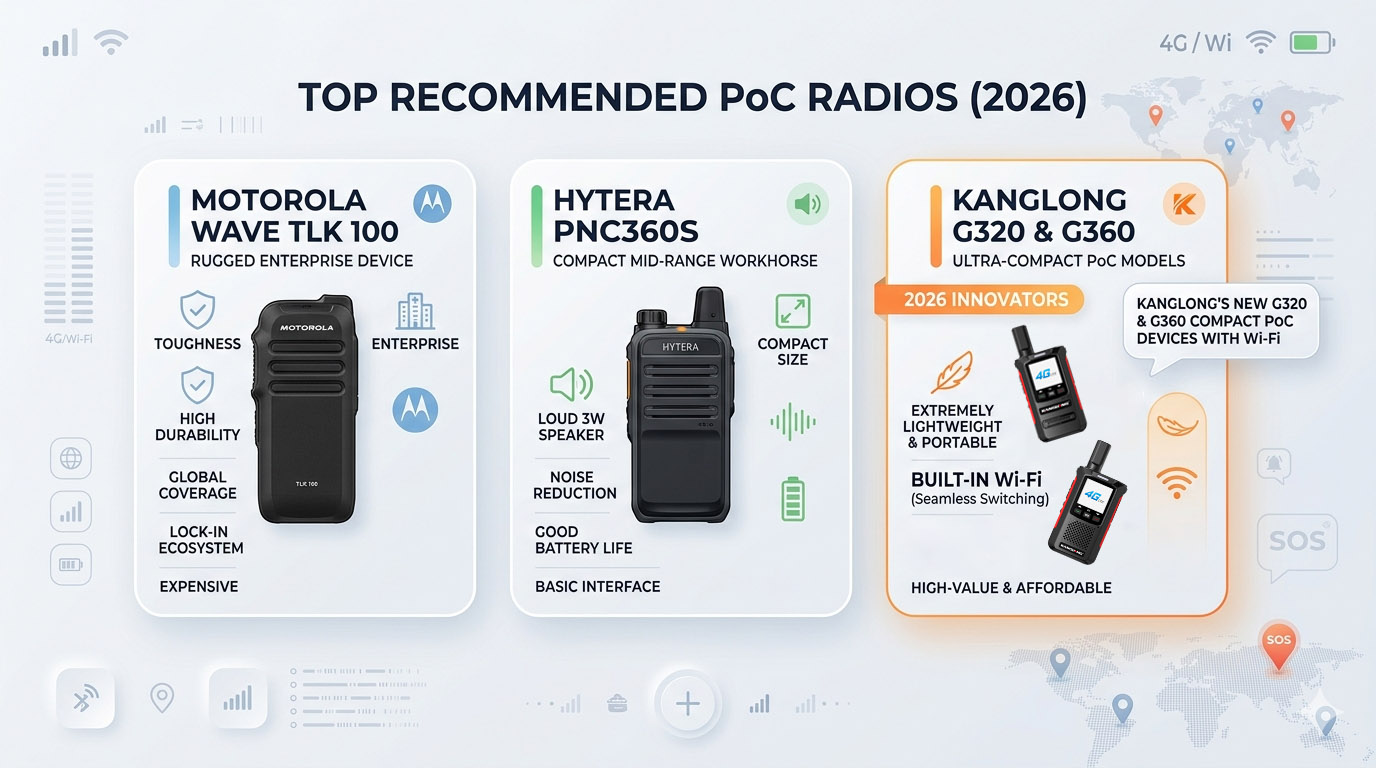
In 2026, Kanglong launched two fresh, ultra-compact PoC models: the G320 and the G360. They designed these specifically to fix the heavy, bulky problem of older radios.
The Good: They are incredibly small, lightweight, and pocket-friendly. Despite the tiny size, they are fully loaded with high-performance Wi-Fi modules. They switch seamlessly between cellular data and your office Wi-Fi, saving you money and eliminating dead zones. Plus, Kanglong focuses on honest, real-label battery and audio power, so they won't die halfway through a shift.
The Bad: Because they are designed to be ultra-compact and streamlined, they don't have massive full-sized physical keyboards (but for standard voice communication and easy menu navigation, you don't need one anyway).
Verdict: The perfect, high-value choice for retail, hospitality, property management, and school staff who don't want a heavy brick dragging down their belts.
The days of dealing with crackly, short-range analog radios or paying massive cell phone bills for wide-area coverage are over. By combining the infinite range of cellular networks with the cost-savings and indoor penetration of Wi-Fi, modern PoC radios give you the absolute best of both worlds.
Whether you need real-time GPS tracking for a fleet of trucks, a simple SOS button for your night crew, or a lightweight, pocket-sized Wi-Fi radio like the new Kanglong G320 or G360 for your restaurant staff, the choice is yours. You can customize your setup exactly the way you want it.
Do you have questions about how to set up a Wi-Fi radio network for your business? Drop a comment below or reach out to us for an easy, no-pressure quote!