 English
 عربي
عربي Русский
 Français
 Español
 Deutsch
Through a professional technical team, we provide customers with targeted equipment selection recommendations and comprehensive after-sales services, winning the trust and recognition of customers.



Author
Through a professional technical team, we provide customers with targeted equipment selection recommendations and comprehensive after-sales services, winning the trust and recognition of customers.
In an increasingly globalized industrial landscape, multinational enterprises face unprecedented challenges in maintaining real-time, reliable, and cost-effective communication across diverse geographical locations. Traditional communication methods often force operational managers to make an inefficient compromise between range and operating costs. Traditional Analog Mobile Radios (PMR) provide exceptional, subscription-free localized communication but are strictly limited by physical distance and line-of-sight terrain. Conversely, Push-to-Talk over Cellular (PoC) technology leverages global 4G LTE mobile networks to offer instantaneous, cross-border communication, but it scales poorly in terms of cost when every frontline worker requires a dedicated cellular device, a SIM card data plan, and recurring platform subscription fees.
To bridge this technological divide, KANGLONG RADIO (headquartered in the manufacturing hub of Quanzhou, China) has developed a groundbreaking solution: the KANGLONG PG-60 and PG-66 Dual-Mode Walkie-Talkies. Equipped with an advanced, built-in dual-mode forwarding (gateway) function, these devices serve as an intelligent link between global PoC network infrastructures and localized analog radio frequencies. This article explores the core technical mechanisms behind KANGLONG’s hybrid relay technology and analyzes its real-world economic and operational value through a practical corporate case study.
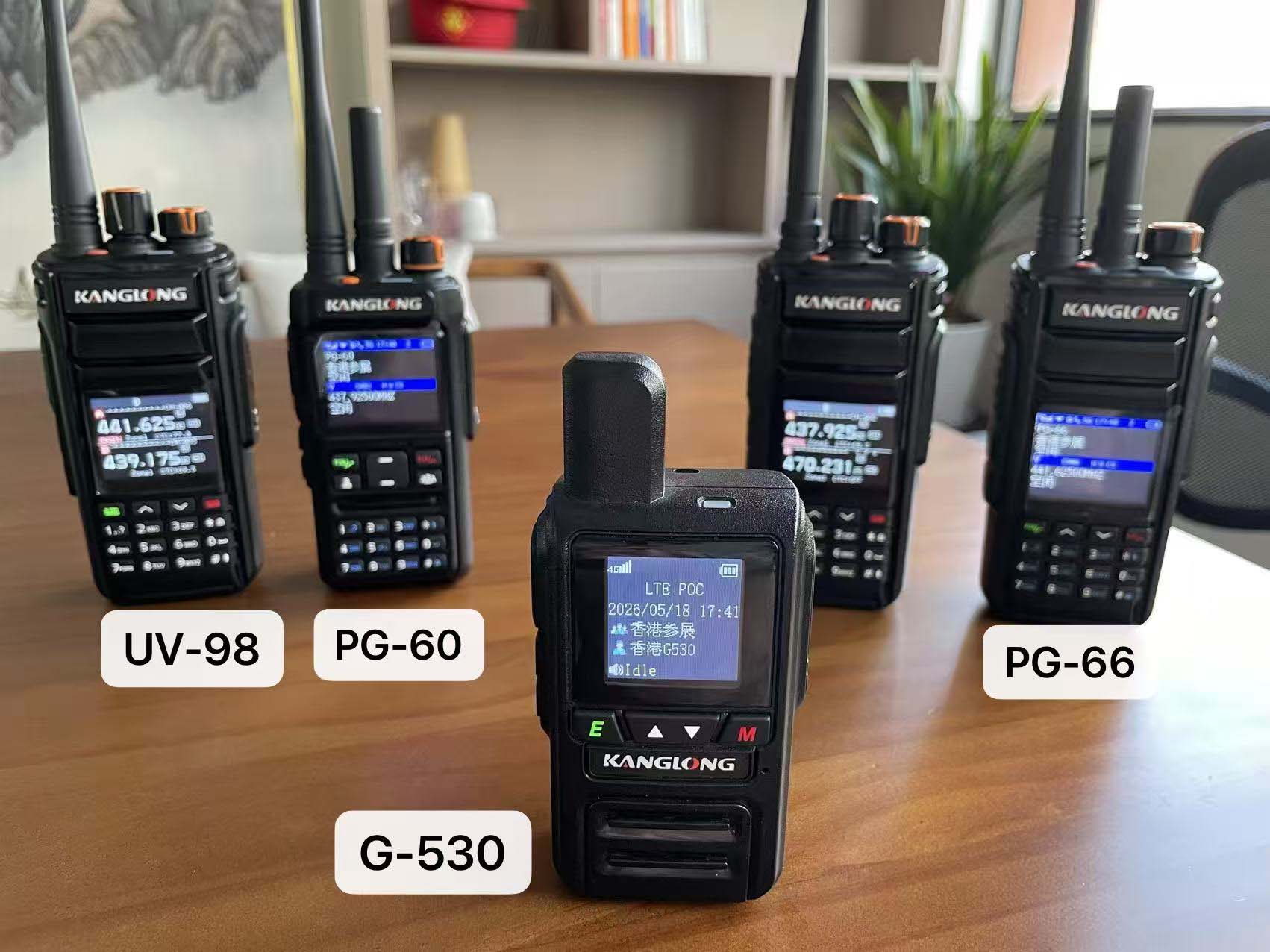
To truly appreciate the engineering innovation behind KANGLONG’s dual-mode systems, it is essential to look at the two distinct communication mediums that the system unifies:
Push-to-Talk over Cellular (PoC): Exemplified by devices like the KANGLONG G-530, PoC technology utilizes public 4G LTE cellular infrastructure. Voice input is digitized, compressed into IP packets, and securely routed globally via dedicated cloud-management networks like the Gxin Platform. The core advantage of PoC is its virtually limitless range; as long as a regional cellular tower is present, a dispatcher can transmit voice messages around the world with sub-second latency. However, large enterprise deployments can become cost-prohibitive if every single warehouse handler or line worker requires an active SIM card and platform license.
Analog RF Radio Technology: Represented by heavy-duty handhelds like the KANGLONG UV-98, analog walkie-talkies rely on local Radio Frequency bands (VHF/UHF). They require no cellular signal, operate independently of internet availability, and incur zero monthly fees. This makes them highly popular for localized environments like factories, retail storefronts, and logistics depots. However, their primary restriction is geographic containment—signals degrade rapidly over long distances or through heavy structural barriers.
The KANGLONG PG-60 and PG-66 dual-mode devices bypass these limitations by acting as a local hardware-level network gateway. When configured to "Transfer / Talk" Mode , the device runs two distinct transceiver architectures simultaneously under a single, high-speed centralized processor.
The bidirectional communication process operates through a fluid translation mechanism:
Downlink Forwarding (PoC to Analog)
A remote user initiates a voice broadcast via a cloud-linked PoC radio from across the globe.
The digital IP data packets travel via the 4G LTE network and are captured by the cellular module inside the localized PG-60/PG-66 gateway via the Gxin Platform.
The internal processor instantly decodes the digital audio packets into a high-fidelity analog stream.
Instead of outputting the audio solely through its built-in speaker, the device automatically routes the signal to its internal RF transmitter module.
The RF module modulates this voice stream onto a pre-configured local frequency and broadcasts it instantly over the air. Any standard local analog radios (such as the UV-98) tuned to that frequency hear the transmission in real time.
Uplink Forwarding (Analog to PoC)
A local operator speaks into a standard UV-98 analog handset on the factory floor.
The localized RF transmission is picked up by the high-sensitivity analog receiver module of the PG-60/PG-66 gateway.
The central processor immediately digitizes the incoming analog voice and encapsulates it into secure IP data packets.
The device uploads these packets via its 4G LTE link directly to the designated Gxin network group, broadcasting the message out to all worldwide PoC users simultaneously.
To see the immense logistical and economic benefits of this system, we can observe its implementation within a multi-site international clothing corporation arranged with the following global layout:
Corporate Headquarters: Located in Beijing, China.
International Branch 1: A manufacturing and distribution facility located in Los Angeles, USA.
International Branch 2: A regional logistics and sales facility located in Melbourne, Australia.
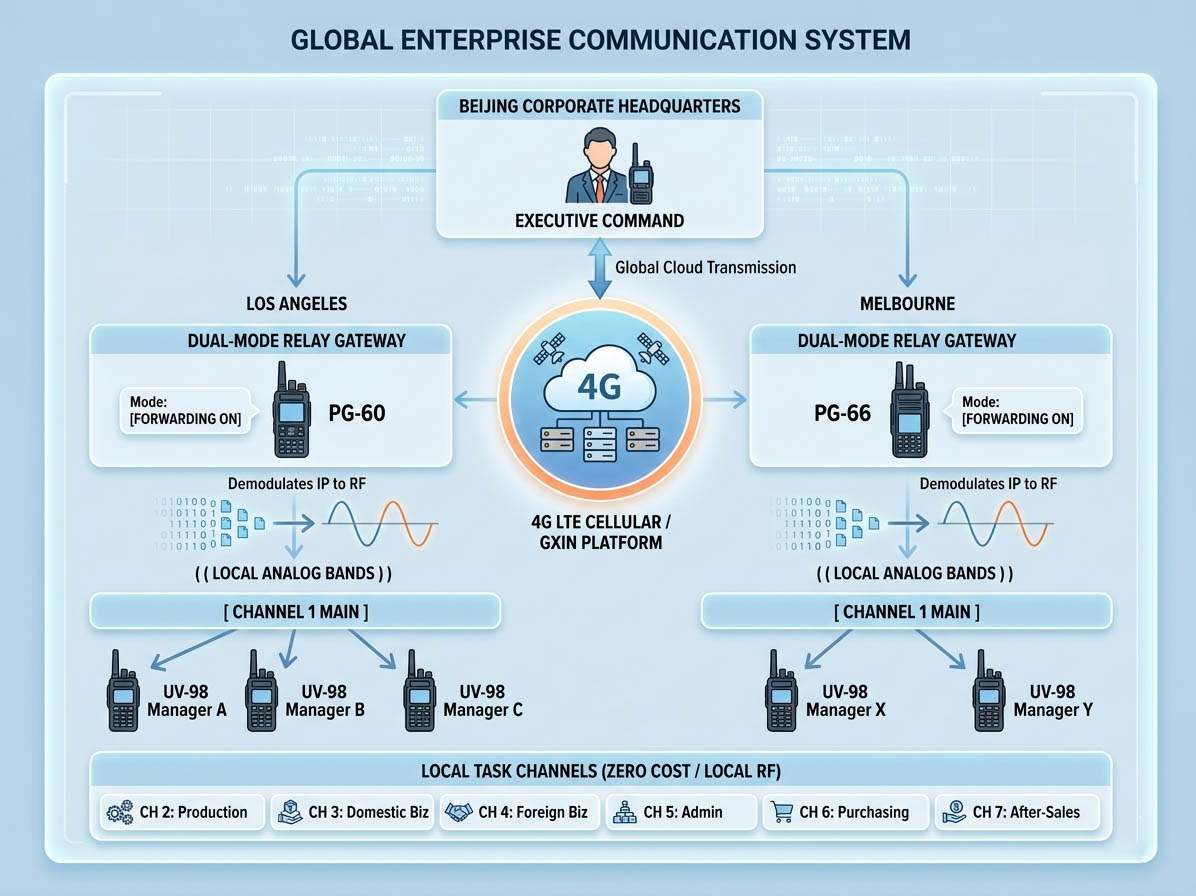
Global Network Topology
To maintain organizational control without clogging airwaves with cross-talk, the company deploys a tiered hybrid framework:
| Location | Hardware Deployed | Operational Configuration |
| Beijing HQ | KANGLONG G-530 (PoC Only) | Connected directly via 4G LTE to the global corporate Gxin group channel. Used by executives for macro-scale dispatching. |
| Los Angeles Branch | KANGLONG PG-60 (Dual-Mode) + Multiple KANGLONG UV-98 (Analog) | The PG-60 sits in a central office on "Forwarding Mode," linked to the global Gxin group and mapped locally to Channel 1. Staff carry UV-98 radios. |
| Melbourne Branch | KANGLONG PG-66 (Dual-Mode) + Multiple KANGLONG UV-98 (Analog) | Identical setup to Los Angeles. The PG-66 acts as the local oceania gateway linking the Gxin network to the local team's Channel 1. |
Local Multi-Channel Hierarchy
To organize internal operations, the analog handsets (UV-98) are programmed with a multi-channel configuration, separating workflows cleanly while keeping the command link intact:
Channel 1 (Global Command Channel): Monitored by all department managers. This channel is reserved for announcements, emergency dispatches, and direct instructions coming from the CEO in Beijing.
Channel 2 (Production Department): Dedicated to internal manufacturing lines, fabric cutting, and sewing floor management.
Channel 3 (Domestic Trade Department): Reserved for local regional sales teams, B2B client pickups, and regional showrooms
Channel 4 (Foreign Trade Department): Used by customs, logistics handlers, and international shipping coordinators.
Channel 5 (Administrative Department): Allocated for HR, facility maintenance, and internal office management.
Channel 6 (Purchasing Department): Dedicated to raw material sourcing, supplier drop-offs, and fabric inventory.
Channel 7 (After-Sales Support): Used by customer service reps, QA engineers, and return-logistics specialists.
Real-World Communication Workflow
When the corporate CEO in Beijing needs to implement an immediate global operational shift, they simply hold the PTT button on their KANGLONG G-530 and speak. The voice signal travels via the 4G LTE network across continents.
In the Los Angeles facility, the KANGLONG PG-60 gateway intercepts the Gxin cloud broadcast, decodes it instantly, and relays it across the airwaves via analog RF on Channel 1. Every department head carrying a UV-98 radio tuned to Channel 1 receives the CEO's directive clearly and simultaneously. Concurrently, the exact same process occurs at the Melbourne branch via the local PG-66 gateway.
Once the global broadcast concludes, local managers switch their UV-98 radios to their assigned departmental channels (e.g., Channel 2 for Production or Channel 6 for Purchasing) to coordinate execution. Their local, high-volume day-to-day chatter stays entirely confined within the free analog spectrum, meaning it costs the company absolutely nothing in data fees, while Channel 1 remains clear for the next global directive.
Significant Total Cost of Ownership (TCO) Reduction
If this global apparel firm equipped all 400 employees across its US and Australian facilities with individual PoC radios, the company would face 400 monthly SIM card bills, extensive cellular data fees, and 400 platform user licenses. By implementing the KANGLONG dual-mode forwarding architecture, the business only pays for three cellular accounts (one for Beijing HQ, one for the LA gateway, and one for the Melbourne gateway). The remaining hundreds of on-site employees utilize subscription-free analog hardware, slashing ongoing operating expenses (OPEX) by up to 90%.
Infinite Range Combined with Bulletproof Local Autonomy
Local teams retain 100% operational autonomy. If an internet provider outage disrupts a branch's external connectivity, the internal factory teams can still talk seamlessly across Channels 2-7 because their analog RF network requires no external web services to operate. Once internet connectivity is restored, the dual-mode gateway automatically re-links the facility back to the global command center in Beijing.
The KANGLONG PG-60 and PG-66 Dual-Mode Forwarding technology represents a major evolutionary step in commercial radio frequency deployment. By expertly acting as a low-latency bridge between cellular IP protocols and local RF waves, KANGLONG RADIO empowers modern enterprises to deploy massive, multi-department networks that offer worldwide connectivity without the financial burden of large-scale cellular data contracts.