 English
 عربي
عربي Русский
 Français
 Español
 Deutsch
Through a professional technical team, we provide customers with targeted equipment selection recommendations and comprehensive after-sales services, winning the trust and recognition of customers.



Author
Through a professional technical team, we provide customers with targeted equipment selection recommendations and comprehensive after-sales services, winning the trust and recognition of customers.
Long-Range Walkie Talkie Buying Guide for Businesses | Complete LoRa Mesh System
Discover how a complete LoRa Mesh radio system connects D600 handheld radios with D6000 fixed repeaters, D6000E vehicle repeaters, D6000R portable repeaters, and D7000 solar repeaters for reliable off-grid business communication.
LoRa walkie talkie, LoRa Mesh radio, walkie talkie repeater, off-grid communication, vehicle repeater, solar repeater
Businesses working in mountains, tunnels, mines, construction sites, remote farms, wind farms, emergency zones, and large industrial facilities cannot always depend on cellular service or traditional communication infrastructure. In these environments, a long-range walkie-talkie system must do more than provide a strong signal from one handheld to another. It must create a communication network that can adapt to distance, terrain, obstacles, vehicle movement, and changing work zones.
KANGLONG’s LoRa Mesh solution is designed as a complete radio ecosystem rather than a single walkie-talkie model. The system combines handheld radios with fixed, vehicle-mounted, portable, and solar-powered repeaters. The core product family includes the D600 handheld radio, D6000 fixed repeater, D6000E vehicle repeater, D6000R portable repeater, and D7000 solar repeater. Additional handheld options include the D750, D680, and D380.
This guide explains how the system works, how the models work together, and how businesses can choose the right LoRa Mesh configuration for reliable off-grid communication.
The image below shows the typical role of each network component: handheld radios support field users, while different repeater formats create the communication backbone for fixed, mobile, temporary, or permanent deployments.
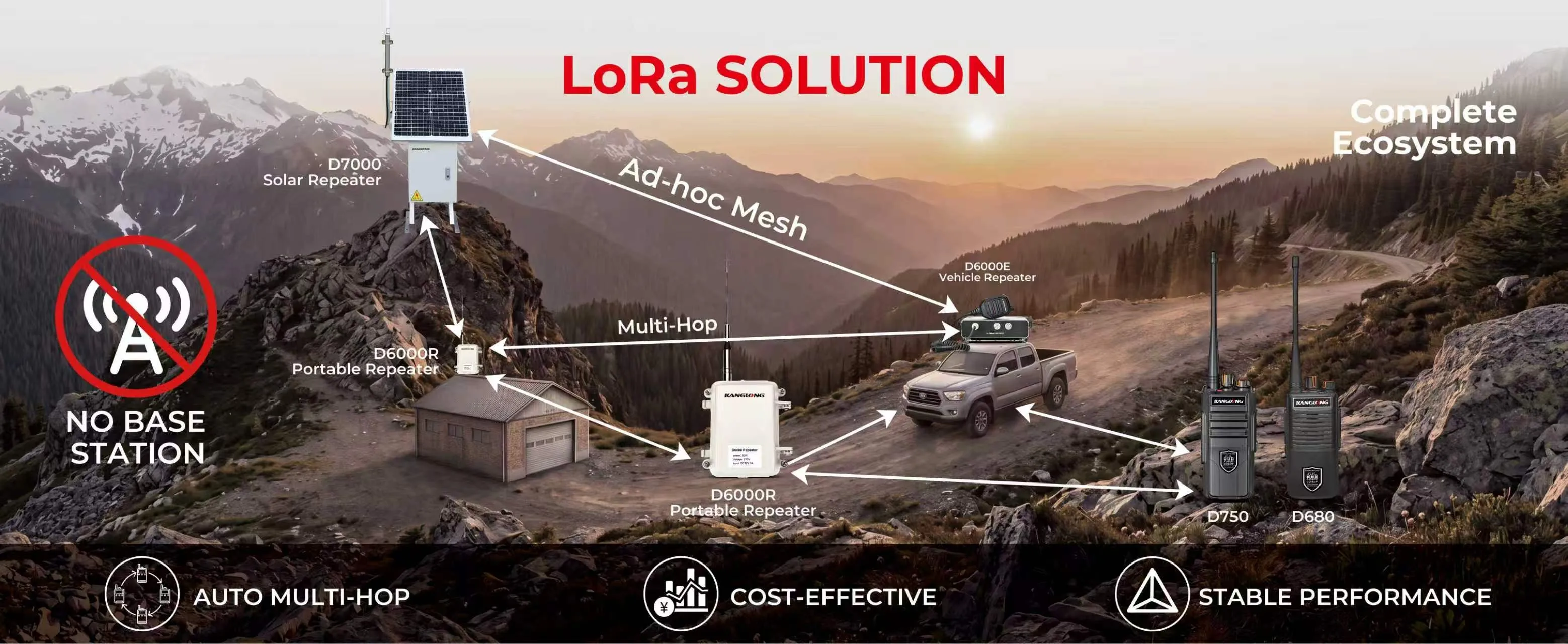
A complete deployment can be organized into four layers:
This architecture allows a business to select different radio types for different users and locations while maintaining one coordinated mesh communication system.
LoRa Mesh is a long-range radio communication architecture that combines long-range radio transmission with ad-hoc mesh networking. In a conventional radio system, users may need a direct line of sight or a central repeater. In a mesh system, compatible radios and repeaters can communicate through multiple nodes.
The signal can move from one device to another until it reaches the intended user. This helps the network work around obstacles such as mountains, tunnel bends, concrete structures, industrial buildings, and uneven terrain.
A complete business LoRa Mesh system may include:
The key advantage is system flexibility. A business does not have to use the same type of device at every location. It can match each model to the role it needs to perform.
KANGLONG’s product information describes a proprietary LRAN 1.0 protocol built around an STM32F4 control platform and an SX1278 RF transceiver. The system operates within the UHF 400–510MHz band according to the product category information. Compatible devices can form a localized Long Range Automatic Network when powered on and configured for the system.
The network can combine mobile handheld radios, vehicle-mounted units, and different repeater types. This means the communication structure can follow the actual operation instead of being limited to one fixed point.
For example, a field worker may use a D600 handheld radio, a maintenance vehicle may carry a D6000E vehicle repeater, and a remote ridge may use a D7000 solar repeater. These devices can work as network nodes within the configured system.
The product information describes the handheld, vehicle radio, and repeater nodes as capable of operating as both transceivers and relays. When a direct path is weak or blocked, the signal can be forwarded through another available node.
This is especially useful in:
KANGLONG’s LoRa Mesh product information specifies up to 30 levels of relay jumping. This means that a signal may pass through multiple compatible nodes to route communication around obstacles and extend network reach.
Thirty relay levels should not be interpreted as a guaranteed number of kilometers. Actual coverage depends on node spacing, terrain, antenna height, interference, weather, building materials, radio configuration, and local operating conditions.
The system uses RSSI, or Received Signal Strength Indicator, and SNR, or Signal-to-Noise Ratio, thresholds to assess link quality. When a direct link is strong, the system can avoid unnecessary repeating. When the direct link weakens, the mesh can forward the communication through another route.
This adaptive behavior helps reduce reliance on a single communication path. Businesses should still perform a field test and establish a deployment plan before using the system for safety-critical operations.
The D600 is a 5W long-range LoRa Mesh walkie talkie. The product page describes it as a handheld radio for dead zones, tunnels, basements, remote farms, and other areas where conventional communication may be unreliable. It supports 30-level signal jumping according to the product information.
The D600 is the most direct choice when a business needs a practical handheld radio for workers who move around a site. It can be used as a field communication device while also participating in the mesh network as a node.
Typical users:
View the D600 long-range LoRa Mesh walkie talkie
The D6000 is a 20W long-range walkie-talkie repeater designed to build an automatic mesh network with 30-level signal jumping. In a complete deployment, it serves as the fixed repeater or permanent network-backbone option.
A D6000 can be positioned at a suitable fixed location to support coverage across a plant, worksite, industrial compound, tunnel entrance, or other permanent operating area. The actual installation point should be selected through a site survey that considers antenna height, terrain, power availability, and required coverage.
Typical users:
View the D6000 fixed long-range repeater
The D6000E is an 18W vehicle-mounted UHF repeater with 16 channels and 30-level auto-mesh technology. It allows a vehicle to act as a mobile network node and can support communication between moving teams and ground-based users.
This model is useful when the coverage requirement changes with vehicle movement. A patrol vehicle, field-service truck, rescue vehicle, or logistics vehicle can carry the repeater into an area where a fixed network backbone is not available.
Typical users:
View the D6000E vehicle-mounted repeater
The D6000R is an 18W portable mesh repeater with a listed 10,000mAh battery and 30-hop auto-mesh technology. It is designed for situations where a business needs to create or restore a communication network quickly without waiting for permanent infrastructure.
The portable format makes the D6000R suitable for emergency rescue, search operations, temporary construction zones, disaster response, outdoor events, and remote work sites. Teams can position it where it provides the most useful relay path for the current operation.
Typical users:
View the D6000R portable long-range repeater
The D7000 is a 20W solar-powered LoRa Mesh repeater with a listed 20Ah battery and 30-level signal jumping. It is designed for permanent off-grid network coverage where access to grid power is difficult or unavailable.
The solar-powered format can support long-term deployment at remote locations such as mountain ridges, wind farms, large agricultural estates, border-area infrastructure, and isolated work zones. Installation planning should include solar exposure, battery reserve, antenna position, weather conditions, physical security, and local requirements.
Typical users:
View the D7000 solar-powered long-range repeater
The core field-user role can be configured with several handheld models depending on the operating environment.
The D750 is an 8W IP68 long-range ad-hoc mesh handheld radio. The product page highlights its 30-level continuous jump transfer function and IP68 waterproof protection for complex environments such as tunnels and basements.
Choose the D750 when field teams need a higher-power handheld with a rugged waterproof design.
View the D750 IP68 mesh handheld radio
The D680 is a 5W long-range ad-hoc mesh handheld radio with product information highlighting 30-level relay jumping for tunnels, basements, and no-signal environments. It is a suitable option for general business teams that need a high-power mesh handheld.
View the D680 mesh handheld radio
The D380 combines a compact form factor with 5W output. It is positioned for underground construction and mining, where workers may benefit from a smaller radio that can still participate in a relay-based off-grid network.
View the D380 compact LoRa handheld radio
A long-range walkie-talkie system does not have one universal distance figure. In a LoRa Mesh network, coverage is determined by the complete combination of handhelds, repeaters, antenna locations, node spacing, power, terrain, and radio conditions.
Terrain: Mountains, ridges, rock, tunnel bends, and underground structures can block a direct path.
Node spacing: Nodes must be positioned so that neighboring devices can maintain a stable link. More relay capability does not replace good deployment planning.
Repeater location: A fixed D6000 or solar D7000 can provide a stronger backbone when installed at a suitable elevated or strategically located position.
Mobile coverage needs: A D6000E vehicle repeater can move with the operating team, while a D6000R can be placed temporarily at a changing work location.
Transmit power: The listed product range includes 5W and 8W handheld radios, plus 18W and 20W repeater options. Higher power does not automatically guarantee better coverage in every environment.
Power availability: A D6000 may suit a site with stable power, a D6000R provides portable battery-powered deployment, and a D7000 is intended for solar-powered off-grid operation.
Local regulations: Businesses must confirm that frequencies, power levels, antennas, and deployment methods meet the requirements of the operating country or region.
The best procurement method is a site-specific field test rather than a purchase decision based only on a maximum-distance statement.
LoRa Mesh is useful when a team needs local communication without depending on a cellular operator or public data network. The KANGLONG LoRa category describes a system that does not require SIM cards, monthly platform contracts, or ongoing data fees for the local radio network.
Potential operational benefits include:
Off-grid communication still requires responsible planning. Businesses should prepare spare batteries, charging procedures, backup radios, user training, radio discipline, emergency procedures, frequency authorization, and routine equipment inspections.
Use D600, D680, D380, or D750 handheld radios for workers, then combine them with a D6000 fixed repeater for a permanent underground or surface backbone. In a changing excavation area, a D6000R portable repeater can be positioned closer to the active work zone.
Thick concrete walls, steel structures, and tunnel bends can create dead zones. D600 handheld users can communicate through a relay structure supported by a D6000 fixed repeater or a temporarily positioned D6000R.
A rescue team may need a network immediately after arriving in a remote area. D6000R provides the portable repeater role, while D600 handhelds, D750 radios, and D680 radios can support team members. If rescue vehicles are moving through the area, D6000E can extend the network from a vehicle.
Emergency teams may be distributed across several zones. A D6000R can provide rapid temporary coverage, while D6000E can extend communication as response vehicles move. All-call, group-call, individual-call, and SOS functions can support operational coordination when correctly configured.
Large farms and forestry operations may have weak cellular coverage across fields, hills, and access roads. D600 handhelds can support workers, D6000E can follow mobile teams, and D7000 can provide a long-term solar-powered relay at a strategic remote location.
Wind farms, utilities, pipelines, and distributed infrastructure often need a mixture of fixed and mobile communication. D7000 can support permanent off-grid coverage, D6000 can serve a fixed operational base, D6000E can accompany inspection vehicles, and D600 handhelds can support field personnel.
Use the D600 as a practical standard field handheld. Consider the D750 when IP68 protection and 8W output are priorities, the D680 for a 5W high-power mesh handheld, and the D380 when a compact format is important for underground or confined work.
Mark tunnels, ridges, buildings, roads, work areas, control rooms, vehicle routes, and emergency assembly points. This map will help determine where repeaters should be installed or positioned.
A fixed D6000 requires a suitable fixed installation and power plan. A D6000R depends on its portable battery supply. A D6000E depends on vehicle installation and operating conditions. A D7000 requires suitable solar exposure, battery planning, and physical protection.
The KANGLONG product information describes 16-channel capability for the D6000E and supports all-call, group-call, and individual-call functions across the system. Confirm the exact configuration required for your deployment before purchase.
Test the complete system in the actual environment. Include the expected user locations, vehicle movement, terrain changes, building materials, antenna positions, interference, weather conditions, and emergency communication procedures.
The D600 is a 5W handheld radio intended for field users. The D6000 is a 20W fixed long-range repeater intended to provide a stable network backbone for a permanent or semi-permanent site.
The D6000E is an 18W vehicle-mounted repeater designed to provide mobile coverage from a vehicle. The D6000R is an 18W portable repeater with a listed 10,000mAh battery for temporary, emergency, or rapidly deployable network coverage.
The D7000 is a 20W solar-powered repeater with a listed 20Ah battery. Its role is to support permanent off-grid network coverage at remote locations where regular wired power may not be practical.
The listed handheld models are the D600, D750, D680, and D380. The D600 is the standard 5W LoRa Mesh handheld option; the D750 is an 8W IP68 model; the D680 is a 5W high-power mesh handheld; and the D380 is a compact 5W LoRa handheld.
The KANGLONG LoRa Mesh solution is described as a local communication network that does not require cellular service, SIM cards, monthly platform contracts, or ongoing data fees. Correct device configuration, deployment, and regulatory compliance are still required.
The product category describes compatible handhelds, vehicle radios, and base stations as capable of acting as transceivers and relays. Actual network behavior depends on the configured system, signal quality, node availability, and operating conditions.
It means the system is described as supporting up to 30 relay-jumping levels. It does not promise a fixed number of kilometers. Actual range depends on node spacing, terrain, antenna setup, interference, and the conditions at the deployment site.
A typical configuration may combine D600 handheld radios for workers, D6000E for vehicle-based teams, and a D7000 solar repeater for permanent remote coverage. A D6000 fixed repeater can be added where there is a permanent operating base with suitable power.
The D6000R is the portable repeater option listed for emergency rescue and search missions. D6000E can support mobile rescue vehicles, while D600, D750, D680, or D380 handhelds can be assigned to field teams according to the operating environment.
Ask for the complete product datasheets, supported frequency and power information, antenna recommendations, battery specifications, configuration software details, channel and calling-mode support, regulatory guidance, field-test support, warranty terms, spare-parts availability, and a proposed network layout based on your site.
A business long-range walkie-talkie system should be selected as a complete communication architecture, not as an isolated handheld purchase. KANGLONG’s LoRa Mesh family provides different nodes for different operational roles:
By matching each model to its correct role, businesses can build a flexible communication system for mines, tunnels, farms, wind farms, emergency response, remote infrastructure, and other locations where cellular coverage or traditional infrastructure is unreliable. The final selection should always be confirmed through a site survey, a field test, and compliance review for the target operating region.