 English
 عربي
عربي Русский
 Français
 Español
 Deutsch
The T-530 is a high-performance analog radio purpose-built for engineering precision, featuring a massive 3600mAh battery for unrivaled shift endurance.
Read More

"Blind Lifting" a Hundred Meters Up—If the Construction Walkie-Talkies Fail, Who Takes the Blame?
Hey there, fellow engineers, site managers, and project pros. Let’s bypass the usual corporate talk today and focus on the giant steel beasts hovering over our heads every single day—construction site tower cranes.
In the world of civil engineering, effective communication is the ultimate key to project success. But let’s be honest: between the deafening roar of heavy machinery and the massive distances between teams, the construction site can be a communication nightmare. That is exactly why two-way radios for construction sites are an indispensable tool.
The benefits of a robust construction wireless communication system are clear across the board:
Instant Communication: With a simple push-of-a-button (PTT), workers can instantly talk to colleagues in different zones, speeding up decision-making and preventing costly task delays.
Durability and Impact Resistance: These heavy-duty construction walkie-talkies are ruggedly built to survive dust, moisture, mud, and hard drops—making them the ideal choice for harsh jobsite environments.
Ultimate Ease of Use: With an intuitive interface and easy-to-operate buttons, even workers who have never touched a two-way radio can master them in seconds.
Site Safety: Jobsite walkie-talkies play a critical role in worker safety, allowing safety officers to broadcast instant warnings about potential risks and precautions to the entire team.
On a modern jobsite, when the tower crane starts swinging, your walkie-talkies are the only thing keeping that high-efficiency, high-risk lifeline together.
On any active site, a standard crane lifting workflow requires flawless, real-time coordination among the ground rigger, the ground signalman (director), and the tower crane operator. It’s a perfect example of how construction site two-way radios are used in daily logistics:
Step 1: The Morning Check & Team Coordination. At dawn, the crane operator climbs hundreds of feet up to the cabin. Once inside, the heavy equipment operator must immediately run a radio check with the supervisor or ground crew: "Tower 1, do you copy? Loud and clear?" Once connection is confirmed, they coordinate the day’s lifting schedule.
Step 2: Material & Equipment Logistics. Ground riggers secure tons of steel or concrete with wire ropes. The signalman grabs his construction walkie-talkie and calls out: "Tower 1, lift up! Slow and steady, watch the swing!" This ensures materials land exactly where they need to be, exactly when they're needed.
Step 3: The Dangerous "Blind Lift". As the building grows higher, the crane operator’s line of sight is completely blocked by the concrete core walls. Sitting in the clouds, the operator is flying blind. They rely entirely on the voice in their earpiece: "Turn left a bit... hold it... okay, stop! Move the trolley!" During a blind lift, that construction two-way radio is the operator's eyes. It cannot cut out.
Step 4: Precision Placement & Safety Alerts. The load reaches the target floor, and the signalman directs: "Lower the hook, slowly... okay, stop!" The floor crew unloads the materials. If any sudden hazard arises during this process, safety personnel can instantly use the wireless radio communication system to broadcast a site-wide safety alert, evacuating the crew in seconds.
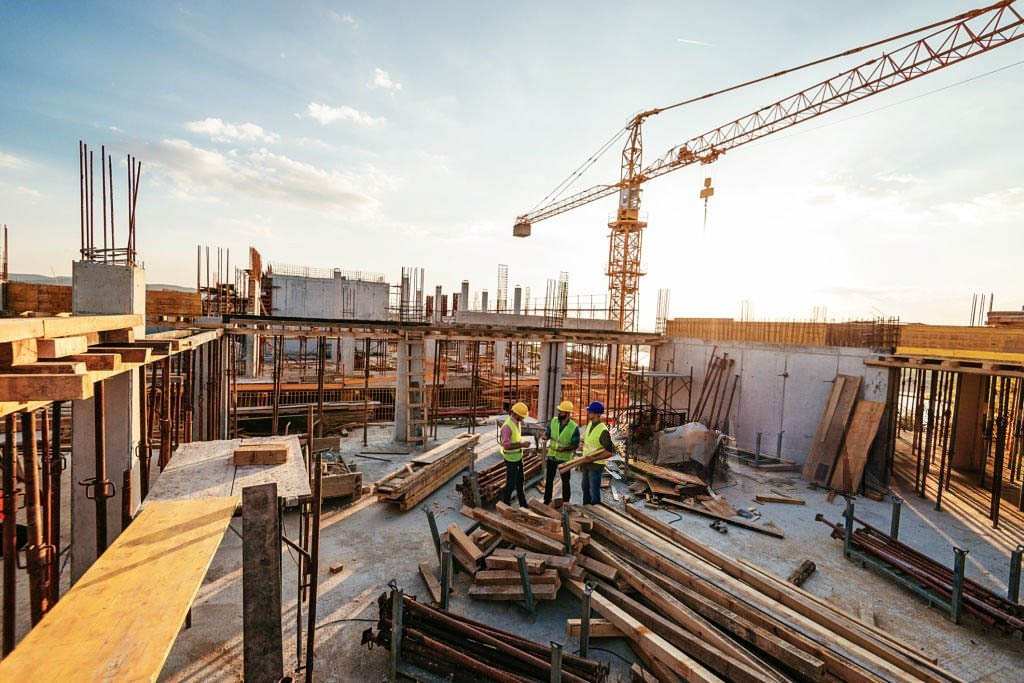
If you run a construction site, you’ve probably been burned by these common construction radio headaches:
Multi-Crane Cross-Talk (Channel Chaos): Large scale projects usually feature multiple cranes working simultaneously—like Tower Cranes 1 through 5. If everyone uses the same channel, Tower 1’s director blares into the ears of operators 2, 3, 4, and 5. The overlapping chatter causes confusion, missed cues, and massive safety risks.
Signal Blind Spots & Concrete Interference: Dense steel rebar grids, concrete cores, and metal scaffolding act like a shield against radio waves. Cheap, low-tier walkie-talkies fill up with static or drop signals entirely when lifting inside a high-rise core, leaving the operator stranded.
Short Battery Life & Charging Nightmares: Crane operators pull 10-to-12-hour shifts up there. If a handheld walkie-talkie battery dies halfway through the afternoon, the lift stops, the ground crew stands around, and money bleeds. Plus, jobsites are notorious for chaotic charging setups and mismatched cables.
To eliminate these daily headaches, our project sites have upgraded to the KANGLONG T530 Construction Site Two-Way Radio. After putting it through its paces on-site, the crews are all saying the same thing: "This is the tough-as-nails tool we've been waiting for."
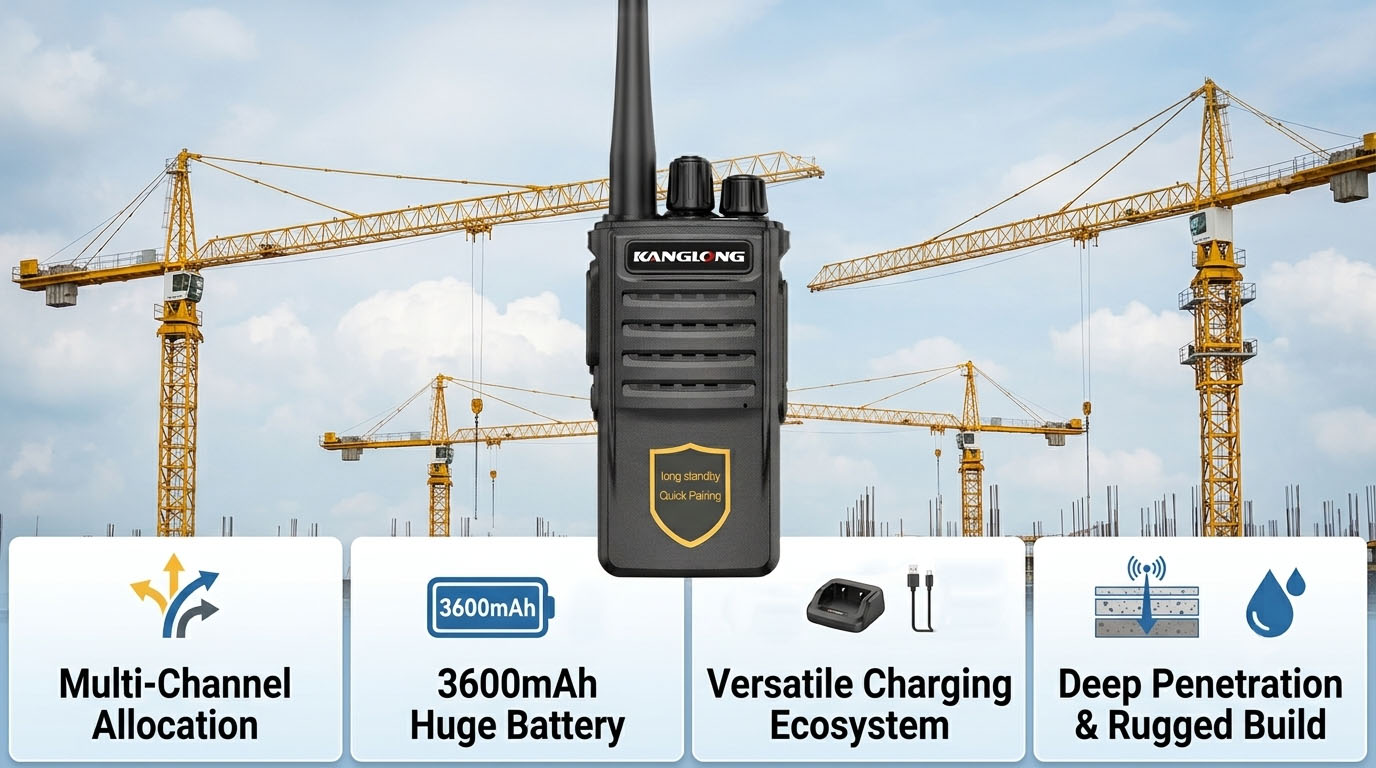
To solve the chaos of multi-crane operations on massive sites, the KANGLONG T530 features independent multi-channel configuration. On our active projects, we allocate dedicated independent channels 1 to 5 for Tower Cranes 1-5 respectively. Each crane team gets its own private, interference-free channel. Meanwhile, the ground crew, safety inspectors, and logistics teams utilize the remaining independent channels. No more overlapping cross-talk, just crystal-clear, safe coordination.
Many industrial walkie-talkies cheat on their specs, but the KANGLONG T530 packs an honest, high-capacity 3600mAh battery. Engineered specifically for crane operators who can't just climb down for a swap, the T530 easily lasts through two or three consecutive shifts under high-frequency use.
Even better is its versatile charging ecosystem: it supports traditional desktop drop-in charging docks, direct Type-C charging (meaning you can juice it up with a power bank, laptop, or truck charger), and for fleet management, KANGLONG offers a customized 6-slot multi-unit charger. At the end of the shift, the team just slots their radios into the 6-way charger—neat, organized, and ready for the next shift.
The T530 features an industrial-grade, high-power RF chip optimized for high-density steel and concrete environments. We tested it on a 200-meter-high commercial skyscraper project: a signalman in the basement level could talk to the crane operator at the very top through dozens of floors of solid concrete without a single drop in audio quality. It boasts a loud, crystal-clear speaker that cuts right through concrete vibrators and cutting saws. Plus, it’s built like a tank—if a worker drops it into a muddy puddle, they can just pick it up, wipe it off, and keep on talking.
At the end of the day, wireless communication equipment plays a vital role in civil engineering. It drives team coordination, optimizes operational efficiency, and keeps your workforce safe. With its instant PTT capability and rugged shell, the right radio is a non-negotiable tool for the modern construction site.
If you’ve been in construction long enough, you know one golden rule: Never cheap out on safety and communication gear. Saving a few bucks on low-quality radios will cost you thousands in downtime, missed lifts, and project delays. Since switching our crane crews to the KANGLONG T530, our vertical transport efficiency has skyrocketed, and our site supervisors can finally breathe easy. When your team is holding a KANGLONG T530, you know that hundred-meter lifeline is rock solid.
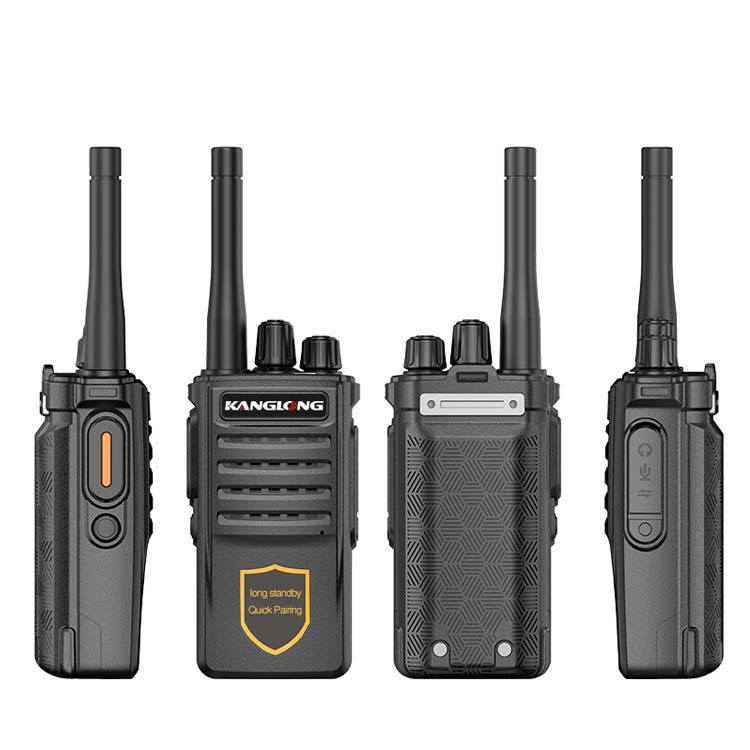
The T-530 is a high-performance analog radio purpose-built for engineering precision, featuring a massive 3600mAh battery for unrivaled shift endurance.
Read More