 English
 عربي
عربي Русский
 Français
 Español
 Deutsch
The D-7000 is a maintenance-free, solar-powered LoRa mesh repeater featuring a 20Ah high-capacity battery and 30-level signal jumping for permanent off-grid network coverage.
Read More


In modern structural engineering, concrete and steel are both structural marvels and electromagnetic barriers. For high-density multi-level developments, skyscrapers, and extensive multi-tier subterranean complexes, this structural mass presents an unforgiving RF propagation landscape. Conventional communication frameworks force engineering and facilities managers into an inefficient compromise: accept the strict line-of-sight physical limitations of disconnected standalone hardware, or commit to compounding monthly operational costs, platform subscription fees, and deep-level structural dead zones characteristic of cellular-dependent Push-to-Talk over Cellular (PoC) networks.
To break this multi-decade compromise, KangLong Radio introduces an architectural paradigm shift. By deploying an autonomous decentralized network framework that eliminates foundational infrastructure dependencies, large scale industrial operations can now unlock absolute top-to-bottom coverage across extreme vertical and subterranean topologies. This whitepaper analyzes the technical mechanics, embedded algorithmic rules, and localized deployment strategies utilized to secure seamless connectivity across a 22-floor high-rise and 9-level deep basement profile.
In traditional radio coverage engineering, attempting to bridge communications across a 22-story above-ground building and a 9-level deep reinforced basement complex using standard Analog PMR or digital DMR systems involves severe physical and financial hurdles. Historically, the only viable method to ensure penetration across such thick concrete floor decks has been the implementation of an indoor Distributed Antenna System (DAS) or extensive coaxial cable cross-linking.
LEGACY ANALOG & DMR INFRASTRUCTURE BOTTLENECKS
Prohibitive Capital & Labor Expenditures: Achieving coverage requires engineering teams to vertically install hundreds of meters of heavy, low-loss RF coaxial cables or radiating leaky feeders throughout the central risers. This demands intrusive core drilling across multiple structural firewalls, extensive cable tray routing, and the deployment of expensive power splitters, bi-directional inline amplifiers (BDAs), and couplers. The implementation process frequently stretches over weeks, absorbing massive budgets in manual labor and structural structural modifications. Furthermore, any physical cable failure or joint oxidation caused by subterranean humidity can isolate the entire network, turning troubleshooting inside hidden concrete conduits into an impossible task.
THE KANGLONG WIRELESS MATRIX ADVANTAGE
True Infrastructure-Free Deployment: The KangLong LoRa ad-hoc mesh architecture eliminates vertical RF feeder lines, external cabling, and structural structural adjustments entirely. Because each relay node auto-configures wirelessly, deployment timelines collapse from weeks to a matter of hours. There are no inter-floor lines to drop, no cables to strip, and no complex engineering networks to maintain. This clean-slate approach directly cuts hardware allocation and labor overhead by more than 80%, guaranteeing a highly resilient, adaptive network topology that expands naturally alongside the building's layout.
The capability to penetrate deeply shielded structural environments without high-power centralized base stations relies on the LRAN (Long Range Automatic Networking) 1.0 Protocol. Developed by KangLong Radio, this custom digital networking protocol converts standalone terminal endpoints into intelligent, dynamic routing nodes.
The underlying hardware pairs an industrial-grade STM32F4 series microcontroller for high-speed algorithmic execution with an ultra-robust SX1278 RF transceiver engine operating in the UHF 400–510MHz spectrum. Rather than relying on consumer-grade mesh topologies that suffer from severe data packet collisions and latency degradation during voice transmission, LRAN 1.0 introduces a dedicated digital scrambling matrix and an embedded vocoder soft core driven by a WT2031 hardware engine. This configuration produces highly
compressed digital voice packets that achieve absolute legibility even under extreme path loss conditions, registering a Bit Error Rate (BER) of less than 5% at an ultra-sensitive receiver threshold of -120 dBm.
Overcoming the massive structural attenuation of a 9-level basement complex requires a continuous, vertical wireless cascade. A linear cross-floor topology is established by deploying decentralized nodes at critical structural cross-sections, allowing signals to wrap around physical blockages and climb structural boundaries.
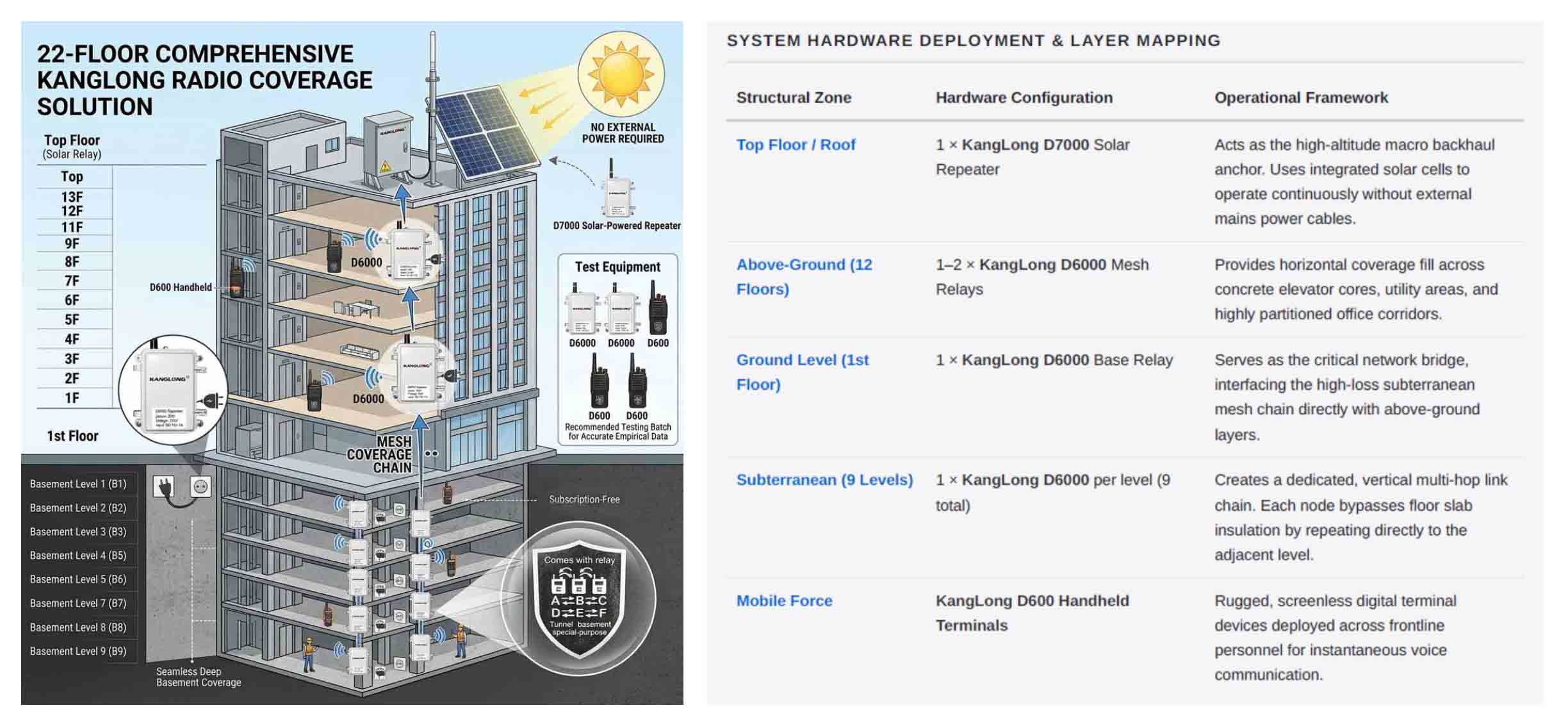
Because reinforced concrete floor slabs effectively neutralize horizontal RF waves, a transmission originating from the deepest subterranean bunker on Basement Level 9 cannot directly reach the open air. Under this topology, the Basement Level 9 D6000 relay captures the signal locally and routes it vertically to the Level 8 relay. The packet cascades hop-by-hop up through the 9 basement layers until it reaches the 1st-floor transition anchor. From this vantage point, the packet is propagated into the upper structures and reinforced by the autonomous D7000 Solar Repeater on the roof, completely securing the communication link.
A primary challenge in ad-hoc mesh networks is preventing packet replication storms. If every node blindly retransmits every detected signal, the spectrum faces immediate data collisions and network lockups. LRAN 1.0 addresses this via real-time embedded edge telemetry execution on the STM32F4 processor. When configured into its autonomous custom routing mode, every KangLong device analyzes inbound packet attributes based on strict threshold conditions:
If (SNR ≥ SNR_Limit) AND (RSSI ≥ RSSI_Limit) → Bypass Forwarding (Network Slot Preserved)
If (SNR < SNR_Limit) OR (RSSI < RSSI_Limit) → Initiate Dynamic Forwarding Matrix
The system parameters are factory-optimized at a Signal-to-Noise Ratio limit (SNR_Limit) of 20 and a Received Signal Strength Indicator limit (RSSI_Limit) of -70 dBm.
For instance, when a safety officer on the 3rd floor communicates with a team member on the 4th floor, the adjacent D6000 relay samples the burst. Telemetry indicates an SNR of 24 and an RSSI of -52 dBm. Recognizing that the hand-held terminals have adequate direct link margins, the relay remains silent, preserving channel
capacity. Conversely, when a maintenance engineer transmits from a shielded electrical vault on Basement Level 3 up to Ground Level, the Level 2 D6000 catches an attenuated signal registering an SNR of 18. Because the metric falls below the threshold variable (SNR < 20), the routing engine instantly intercepts, digitizes, and re-broadcasts the packet, ensuring structural penetration without data loss.
While architectural software modeling provides strong theoretical baselines, localized structural variables—such as rebar density variances, low-E glass coatings, and HVAC steel ducting—require real-world empirical validation to ensure absolute field sign-off.
Recommended Field Validation Kit:
3 × KangLong D6000 Mesh Relays: Placed in a vertical chain across the most isolated subterranean and
ground-level zones to test multi-hop link cascade stability.
2 × KangLong D600 Handheld Terminals: Deployed as roaming test points to track signal boundary drop, execute real-world stress testing, and monitor voice broadcast channel updates.
Utilizing this testing protocol allows facility engineering teams to analyze true attenuation cross-sections, configure precise software modifications, and finalize physical device placements. This empirical approach guarantees optimal network performance from day one, avoiding hardware over-provisioning while ensuring an unbreakable, mission-critical voice loop across the entire multi-tiered enterprise asset.
Migrating to an infrastructure-free, ad-hoc wireless mesh topology represents a decisive operational upgrade for industrial complexes. By replacing extensive physical cabling grids with autonomous, algorithmically managed routing nodes, enterprises eliminate recurring subscription vulnerabilities and single-point system liabilities. With KangLong Radio, critical communication infrastructures naturally integrate into your structural architecture—delivering lightweight, reliable, and cost-effective connectivity designed for the modern industrial era.
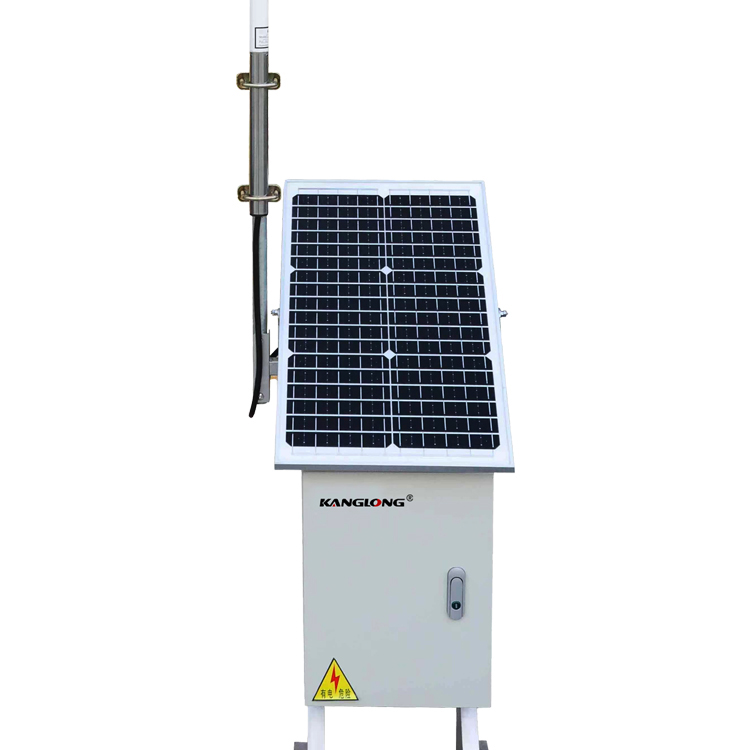
The D-7000 is a maintenance-free, solar-powered LoRa mesh repeater featuring a 20Ah high-capacity battery and 30-level signal jumping for permanent off-grid network coverage.
Read More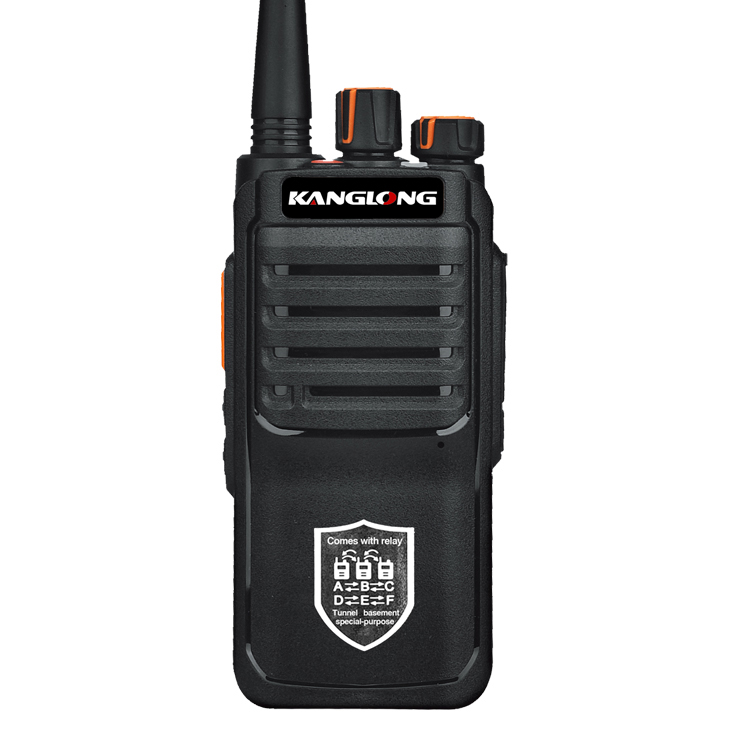
Looking for a long-range radio for dead zones? The D-600 5W Mesh Radio features 30-level signal jumping to provide a robust connection in tunnels, basements, and remote farms. Combining high-power performance with a rugged design, the D-600 is your go-to wireless communication tool for complex underground environments and no-signal areas.
Read More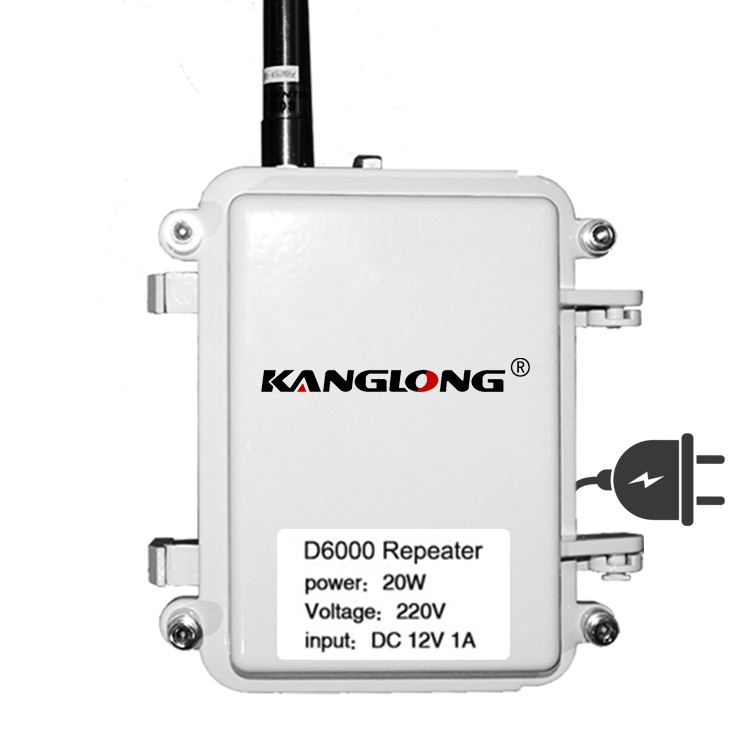
The D6000 is a powerful 20W long-range repeater that builds automatic mesh networks with 30-level signal jumping for total coverage in no-signal zones.
Read More