No Cell Towers in the Desert: How Off-Road Convoys Maintain Unbroken Voice Links
KANGLONG FT-7330UV Mobile Radio: Delivering High-Power, Long-Distance Wireless Connectivity for Remote Fleet Operations
- Application Scenarios: Desert Off-Road · Overland Expeditions · Convoy Logistics & Fleet Support
Introduction: When Communication Matters Most, Cell Coverage Often Fails
As an off-road convoy rolls into open desert and rocky canyon terrain, cellular bars rapidly drop to zero. The lead vehicle clears a high sand dune while the trailing vehicles slow down through soft terrain; the logistics team needs real-time vehicle coordinates, and mechanics await diagnostics on a stalled rig. Though separated by only a few hundred meters, rolling topography and dune ridges can instantly sever direct line-of-sight and voice contact.
For overland convoys, two-way communication is far more than routine trail talk—it is the lifeline for route coordination, rapid recovery, and critical emergency response. Deploying a rugged, autonomous wireless communication network before setting out is essential for keeping dispersed vehicles synchronized and secure.
(Note: The following scenarios are illustrative. Actual communication range and performance depend on local topography, antenna installation, and on-site radio frequency testing.)
1. Convoy Synergy: Every Role Relies on Clear Communication
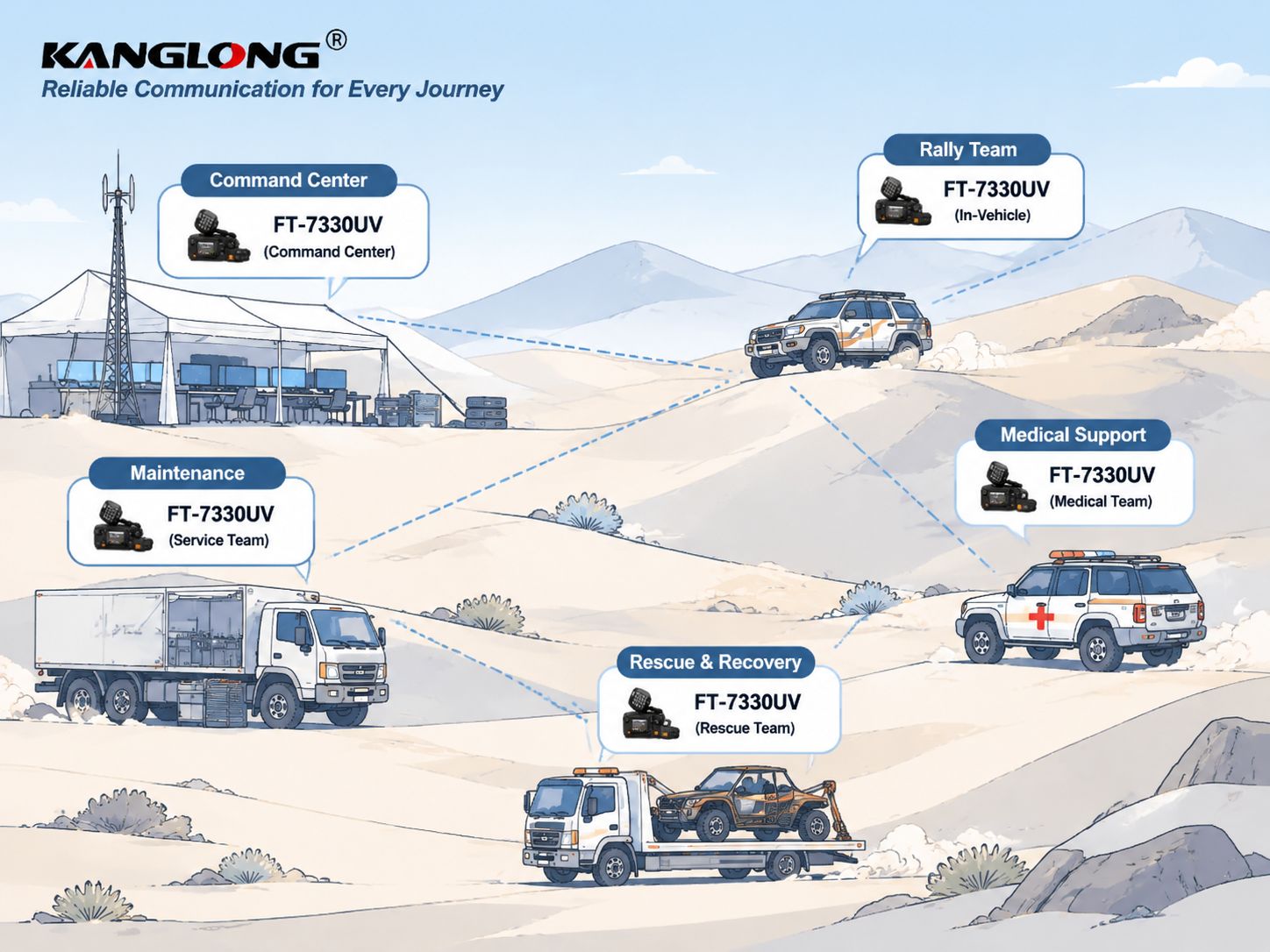
A long-distance overland expedition demands tight coordination across specialized vehicles. The command rig provides navigational guidance, scout vehicles scout trail conditions, service trucks handle mechanical breakdowns and towing, and medical teams remain on standby for emergency response.
| Fleet Role |
Primary Communication Needs |
| Command Vehicle |
Broadcasts rallying points, trail waypoints, and itinerary updates; coordinates group movements across sections. |
| Lead / Scout Vehicle |
Relays real-time trail surface reports, obstacle warnings, and convoy pacing. |
| Recovery & Maintenance |
Receives vehicle fault alerts, coordinates winching, towing, and trailside repairs. |
| Medical Support |
Monitors emergency distress calls and coordinates immediate field response. |
| Participant / Trail Vehicles |
Maintains fleet check-ins and immediately reports stalls, track loss, or trail hazards. |
Without a centralized and standardized communication protocol, message latency and missed calls can quickly compound into safety hazards. In dead zones without cellular coverage, the convoy requires an independent, direct RF (Radio Frequency) communication system.
2. Off-Grid Challenges: What Stands in the Way of Trail Communications?
- Zero Cellular Infrastructure: Remote deserts, salt flats, and wilderness trails lack cell tower coverage, leaving mobile phones completely unusable.
- Topographic Signal Shielding: Sand dunes, dry riverbeds, and elevation drops attenuate RF signals. Physical distance is rarely the sole factor determining signal clarity.
- Complex Multi-Channel Needs: Command, recovery, medical, and participant groups require dedicated communication sub-channels without mutual audio interference.
- Noisy Cabin Environments: High engine RPM, off-road tire hum, and rough terrain vibrations degrade voice intelligibility and make delicate device operation hazardous while driving.
- Urgent Emergency Response Windows: Stalled rigs in soft sand, overheating engines, or medical incidents require immediate, one-touch location and status broadcast.
3. The Strategic Solution: Mobile Transceivers as the Fleet Backbone
In remote off-grid environments, vehicle-mounted transceivers provide immediate vehicle-to-vehicle connectivity without relying on any external infrastructure. Compared to handheld walkie-talkies, mobile radios draw continuous power from the vehicle's 12V/13.8V DC battery system and utilize external high-gain roof-mounted antennas—delivering substantial RF output and superior line-of-sight propagation.
The KANGLONG FT-7330UV dual-band mobile radio is a high-performance analog FM dual-band mobile radio engineered for harsh field expeditions. Featuring dual VHF/UHF operation, flexible high-power output stages, and structured memory management, it seamlessly adapts to multi-vehicle expedition frameworks.
FT-7330UV: Built for High-Impact Convoy Coordination
- 50W VHF / 40W UHF High-Power Output: Features selectable power levels—10W / 20W / 50W (VHF) and 10W / 20W / 40W (UHF)—allowing operators to optimize RF punch according to terrain, distance, and thermal requirements.
- Dual-Band Operation with A/B Dual Display: Manages two active frequencies or memory channels simultaneously on a split-screen interface.
- Dual Watch (Priority Channel Scanning): Automatically alternates monitoring between A and B channels, switching instantly to whichever frequency detects incoming voice traffic—ideal for commanders monitoring group dispatch while keeping a dedicated emergency frequency open.
- 128 Memory Channels per Band (A/B): Enables systematic channel programming by vehicle role, convoy group, or mission phase.
- 2.0-inch HD Color Display: Delivers high-contrast visibility under direct sunlight and dark desert night drives.
- Selective Calling (DTMF / 2-Tone / 5-Tone): Supports individual call, group call, and all-call functions for targeted dispatch.
- Built-in Voice Scrambler: Provides voice inversion privacy for sensitive fleet operational coordination.
- Remote Stun & Kill Functionality: Allows remote device deactivation and reactivation for secure centralized fleet management.
- Wideband Receiver (76–600MHz): Includes FM commercial broadcast and AM aviation band monitoring, expanding field situational awareness.
| Operational Tip: Effective RF communication range is determined by antenna gain, mounting height, ground-plane coupling, and terrain topography—not just raw output wattage. It is highly recommended to conduct full RF link tests with your vehicle fleet and installed antennas prior to entering uncharted terrain. |
4. Fleet Deployment: Matching Devices to Operating Roles
Mobile radios handle heavy-duty in-vehicle communications during high-speed driving and long trail stretches. When support staff step out of their vehicles for winching, track inspection, or mechanical repairs, rugged handheld walkie-talkies bridge the close-range gap. For ground crews, professional handheld two-way radios can complement the vehicle-mounted communication setup.
| Role / Vehicle |
Recommended Hardware |
Operational Application |
| Command Vehicle |
FT-7330UV Mobile Radio |
Maintains fleet dispatch and uses Dual Watch to monitor the general trail channel and emergency channel simultaneously. |
| Recovery & Maintenance |
FT-7330UV Mobile Radio |
Receives real-time distress calls and coordinates rescue vehicle positioning. |
| Lead & Convoy Vehicles |
FT-7330UV Mobile Radio |
Keeps constant convoy voice contact and reports road surface updates. |
| Ground Support Crew |
Compatible Handheld Radios |
Maintains close-range voice links with vehicle drivers during winching, spot-checking, and recovery. |
5. Pre-Trip Best Practices for Seamless Field Comms
- Standardize Channel Matrix: Pre-program all transceivers with unified CTCSS/DCS sub-tones, bandwidth settings (12.5kHz / 25kHz), and channel lists categorized by role.
- Configure Dual Watch on Command Units: Enable dual-watch priority monitoring on lead and safety rigs to ensure emergency calls are never missed during general chatter.
- Optimize Antenna Grounding and Mounting: Mount external antennas on the vehicle roof center with solid RF grounding to maximize 360-degree radiation efficiency.
- Conduct Real-World Route Verification: Perform distance and shadow tests in canyons and behind dunes along the route to identify RF blind zones early.
- Inspect Power and Coaxial Feedlines: Verify DC voltage stability, tight coaxial connector crimps, and microphone cable integrity before departure.
- Equip Handheld Units for Outside-Vehicle Tasks: Ensure ground personnel carry fully charged, frequency-synced portable radios when exiting vehicles.
6. Mobile Radio vs. Handheld vs. PoC: How to Choose the Right Tech?
- Mobile Radio (Vehicle-Mounted): Ideal for mobile units requiring uninterrupted high-power RF transmission, robust vehicle power supply, and maximum line-of-sight range.
- Handheld Two-Way Radio: Best for ground crew, spotters, and field mechanics operating outside vehicle cabins.
- PoC (Push-to-Talk over Cellular): Relies on public mobile carrier networks (4G/LTE), making it suitable for long-distance urban logistics and nationwide dispatch where cell towers are ubiquitous. Explore the 4G PoC radio solutions for communication scenarios that have cellular network coverage.
Verdict: For off-grid desert expeditions, the hybrid combination of Mobile Radios (FT-7330UV) and Rugged Handhelds provides the most reliable communication network.
7. FAQ
Q1: Can the FT-7330UV communicate in areas with zero cell phone reception?
A: Yes. The FT-7330UV operates via direct RF wave propagation between antennas and does not rely on cellular towers, satellite subscriptions, or internet networks.
Q2: What are the primary advantages of a mobile radio over a handheld walkie-talkie?
A: Mobile radios deliver significantly higher RF output (up to 50W vs. 5W–10W on handhelds), use high-gain external vehicle roof antennas, and draw stable power directly from the vehicle’s electrical system.
Q3: Do desert dunes and rock canyons block radio signals?
A: Yes, dense physical obstacles attenuate VHF/UHF signals. Using high-gain antennas, selecting elevated terrain, and setting proper power levels help mitigate shadow loss.
Q4: What frequency bands does the FT-7330UV cover?
A: It supports standard VHF/UHF dual-band transmission with wideband reception across 76–600MHz (including commercial FM radio and AM aviation bands).
Q5: What is the practical benefit of the Dual Watch feature?
A: It allows an operator to monitor two independent frequencies simultaneously (e.g., standard fleet chatter and emergency dispatch), automatically locking onto whichever channel transmits first.
Q6: How can large convoys prevent radio channel cross-talk and confusion?
A: We recommend pre-programming distinct channels with specific CTCSS/DCS sub-tones for command, logistics, and trail vehicles before departure.
Q7: Can the FT-7330UV communicate with other brands of two-way radios?
A: Yes. As long as operating frequencies, channel spacing (narrow/wideband), and privacy sub-tones match, the FT-7330UV is fully interoperable with all standard analog transceivers.
Q8: Does the FT-7330UV support DMR digital mode?
A: No. The FT-7330UV is a dedicated analog FM mobile transceiver and does not interoperate with digital protocols such as DMR or NXDN.
Q9: Is this device suitable for continuous, heavy-duty expedition use?
A: Absolutely. Designed for vehicular power (13.8V DC ±15%), it features a heavy-duty chassis and heat sink for continuous duty cycles under proper ventilation.
Q10: Does KANGLONG provide OEM/ODM customization?
A: Yes. KANGLONG is a professional radio manufacturer with full R&D and manufacturing capabilities, supporting custom branding, housing modifications, and firmware configurations for global clients. Learn more about KANGLONG's radio manufacturing capabilities.
Conclusion: Keeping Every Vehicle Connected Across Every Mile
When traveling beyond cellular infrastructure, dependable two-way communication is the foundation of convoy safety, pace management, and emergency readiness. With the KANGLONG FT-7330UV mobile transceiver, fleet managers and overland enthusiasts gain a powerful, versatile, and crystal-clear voice bridge across rugged terrains.
Planning an overland rally, desert expedition, or commercial fleet project? Contact KANGLONG RADIO today to discuss your vehicle count, terrain conditions, and custom communication requirements.
Product Technical Specifications
| Parameter |
Specification |
| Model Number |
FT-7330UV |
| Operating Mode |
Analog FM, VHF / UHF Dual Band |
| RF Output Power |
VHF: 50W / 20W / 10W | UHF: 40W / 20W / 10W |
| Channel Capacity |
128 Channels each for Band A and Band B (256 Total) |
| Receiver Frequency Range |
76–600 MHz (Segmented RX, includes AM Air Band & FM Radio) |
| Display |
2.0-inch High-Definition Color Screen |
| Operating Voltage |
13.8V DC (±15%, Negative Ground) |
| Antenna Impedance |
50 Ω |
| Dimensions (Main Unit) |
Approx. 150 × 55 × 190 mm |
| Weight |
Approx. 1.0 kg |
(Note: Operating frequencies and hardware configurations may vary by regional compliance standards. Always configure frequency and power output according to local radio regulatory requirements.)
 English
 عربي
 Русский
 Français
 Español
 Deutsch